
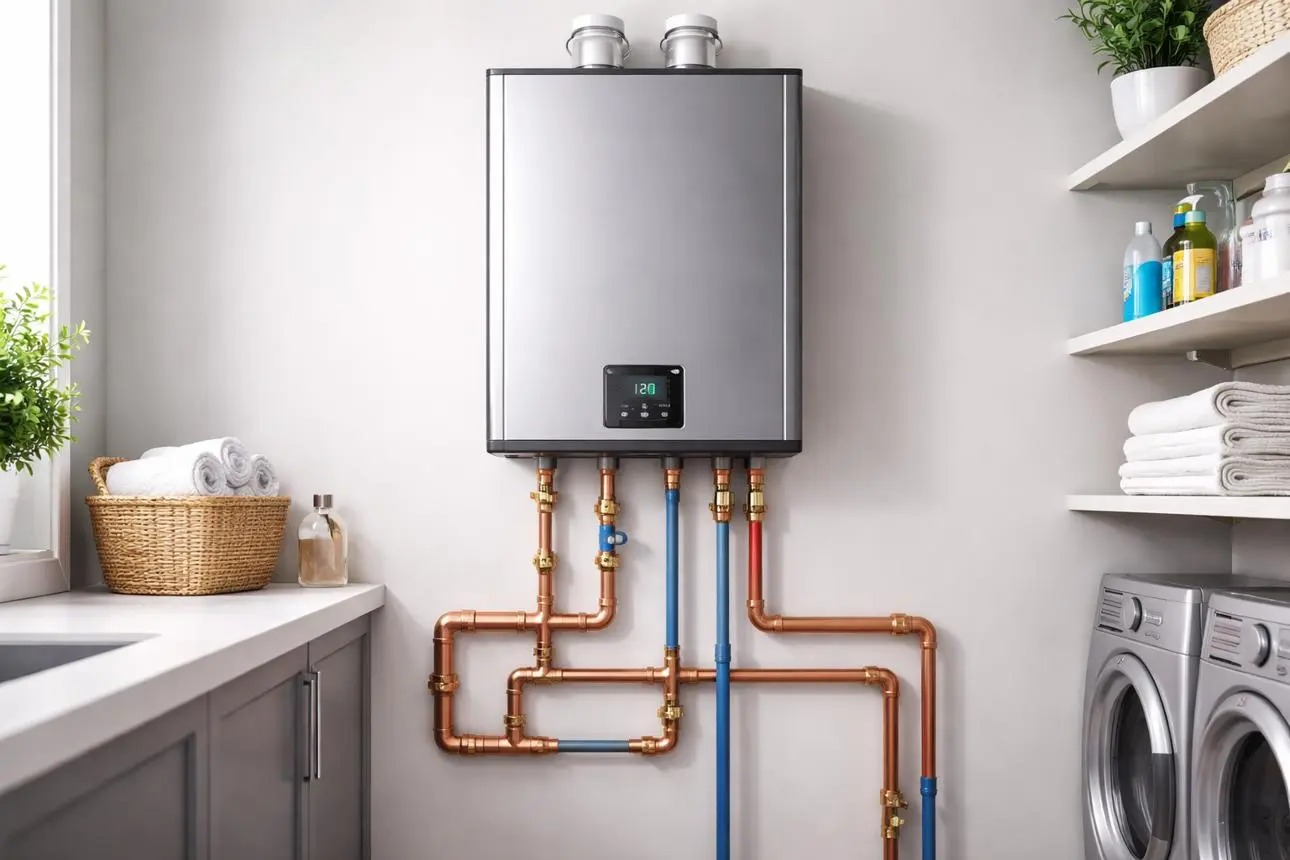
Best Tankless Water Heater: Top Models Compared for 2026
The best tankless water heater depends on your home’s hot-water demand, fuel supply and incoming water temperature. A model rated for 11 gallons per minute (GPM) may deliver much less when it heats very cold water. You also need to consider installation requirements, electrical capacity, maintenance and local repair support.
For a high-efficiency gas system, the Rinnai SENSEI RXP199iN is a strong candidate. The Navien NPE-240A2 is worth considering if you want built-in recirculation. Rheem’s IKONIC range offers another condensing gas option. For electric systems, the Stiebel Eltron Tempra 29 Plus deserves consideration when your electrical service can support it. Smaller units, such as the EcoSmart ECO 11, serve limited point-of-use applications.
This guide compares these models using published specifications. It also explains how to size a unit, compare gas and electric systems, estimate installation needs and avoid common buying mistakes. These recommendations are based on manufacturer specifications. They are not the result of independent laboratory testing or personal product installations.
Quick Comparison: Best Tankless Water Heaters
The table separates whole-house candidates from a small point-of-use model. Their maximum GPM figures are not directly comparable because manufacturers may publish them under different temperature-rise conditions.
Whole-House Tankless Water Heaters
| Model | Fuel | Category | Published UEF | Published Flow Information |
|---|---|---|---|---|
| Rinnai SENSEI RXP199iN | Natural gas / propane | Condensing | 0.98 | Up to 11.1 GPM maximum |
| Navien NPE-240A2 | Natural gas / field-convertible LP | Condensing | 0.95 | 5.6 GPM at 67°F rise |
| Rheem IKONIC ECOHS160iN | Natural gas | Condensing | 0.96 | Up to 8.4 GPM |
| Rinnai RE199iN | Natural gas | Non-condensing | 0.82 | Check model performance chart |
| Stiebel Eltron Tempra 29 Plus | Electric | Whole-house candidate | Check current Energy Guide | 3 GPM at approximately 66°F rise, 240V |
Point-of-Use Tankless Water Heater
| Model | Fuel | Intended Application | Electrical Requirements |
|---|---|---|---|
| EcoSmart ECO 11 | Electric | One or two limited-demand applications | 13 kW, 240V, 54A draw, 60A double-pole breaker |
The EcoSmart ECO 11 is designed for low-flow faucets and smaller applications. It should not be treated as a direct replacement for a high-capacity whole-house heater.
Quick Recommendations
- High-efficiency gas: Rinnai SENSEI RXP199iN
- Built-in recirculation: Navien NPE-240A2
- Rheem gas option: Rheem IKONIC ECOHS160iN
- Non-condensing gas: Rinnai RE199iN
- High-output electric: Stiebel Eltron Tempra 29 Plus
- Small point-of-use application: EcoSmart ECO 11
These are models worth comparing. Your home’s required flow rate and temperature rise determine whether a particular model is suitable.
Best Tankless Water Heaters Reviewed
1. Best High-Efficiency Gas Candidate: Rinnai SENSEI RXP199iN
The Rinnai SENSEI RXP199iN is a condensing gas tankless water heater for natural gas or propane. Rinnai lists a 199,000 BTU maximum input, 0.98 UEF and maximum domestic hot-water flow of 11.1 GPM. The model is recirculation-capable and Wi-Fi-capable.
Published Specifications
| Feature | Rinnai RXP199iN |
|---|---|
| Fuel | Natural gas or propane |
| Technology | Condensing |
| Maximum input | 199,000 BTU/h |
| UEF | 0.98 |
| Maximum listed flow | 11.1 GPM |
| Installation | Indoor or outdoor with required accessory |
| Recirculation | Capable |
| Wi-Fi | Capable |
| ENERGY STAR | Listed by manufacturer |
Its high UEF makes it worth comparing with other high-efficiency gas units. The model also supports two fuel types and offers recirculation capability.
The 11.1 GPM rating is a maximum figure. Ask the installer to check the model’s performance chart at your expected winter temperature rise. Confirm the gas supply, venting, condensate drainage and recirculation arrangement.
Rinnai provides its current product details and technical documents on its official RXP199iN product page.
Suitable for: Homeowners comparing a high-efficiency gas system with natural gas or propane availability.
2. Best Gas Candidate With Built-In Recirculation: Navien NPE-240A2
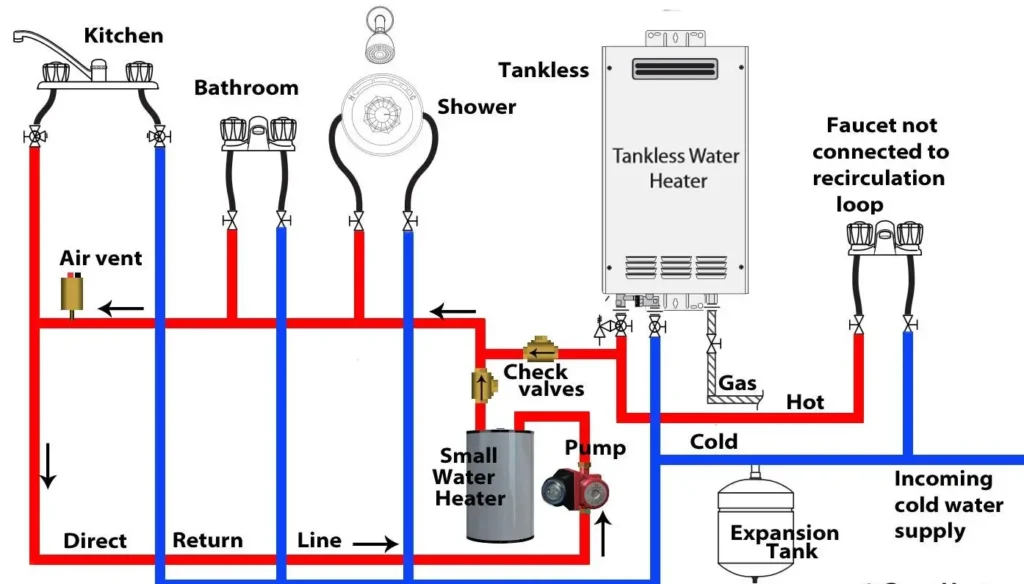
The Navien NPE-240A2 is a condensing gas tankless water heater with a built-in ComfortFlow recirculation system. Its design includes a recirculation pump and buffer tank. This can reduce the wait for hot water when the plumbing system is configured to support recirculation.
Its published flow rates show how temperature rise changes output.
| Temperature Rise | Published Flow Rate |
|---|---|
| 35°F | 11.2 GPM |
| 45°F | 8.7 GPM |
| 55°F | 7.1 GPM |
| 67°F | 5.6 GPM |
| 80°F | 4.9 GPM |
| 100°F | 3.9 GPM |
The model has a 199,900 BTU/h maximum input and a 0.95 UEF. Navien lists ENERGY STAR certification and field conversion from natural gas to LP gas for the NPE-2 models.
Other Features
- Dual stainless steel heat exchangers
- Built-in control panel
- Cascading capability
- Approved venting options, subject to installation limits
- Minimum listed flow of 0.5 GPM in standard configuration
- Water pressure operating range listed by Navien as 15 to 150 PSI
Navien also lists a low-flow option for certain recirculation configurations. Check the manual and configuration requirements before relying on that feature.
Warranty
For residential installations with standard or controlled recirculation, Navien lists 15 years for the heat exchanger, five years for parts and one year for labor. Uncontrolled recirculation can reduce the heat exchanger and parts warranty periods. Review the complete warranty terms before adding an external pump.
Read the specifications and installation information on Navien’s official NPE-240A2 product page.
Suitable for: Homes where reducing hot-water wait time is a priority and the installer understands Navien’s recirculation requirements.
3. Best Rheem Gas Candidate: Rheem IKONIC ECOHS160iN
The Rheem IKONIC ECOHS160iN is a condensing natural gas tankless water heater. Rheem lists an 8.4 GPM rating, 0.96 UEF and a 15-year heat exchanger warranty. The published warranty also includes five years for parts and one year for labor.
The product range includes stainless steel primary and secondary heat exchangers. Rheem lists approved PVC venting options and describes the model as suitable for certain retrofit installations. Its stated gas-line compatibility is subject to length limits and local code.
What Makes It Worth Comparing
- Condensing design
- 0.96 UEF
- 8.4 GPM published rating
- ENERGY STAR certification
- Stainless steel heat exchangers
- Manufacturer-published warranty coverage
The ECOHS160iN and ECOHSR160iN are different configurations. Rheem identifies the SR model as having a built-in recirculation pump. Do not assume the standard ECOHS160iN includes that pump.
Check Rheem’s official IKONIC product information for current specifications, model details and warranty documents.
Suitable for: Buyers comparing a mid-capacity Rheem gas model with other condensing systems. Confirm the exact model’s flow chart before deciding whether it can support your household.
4. Best Non-Condensing Gas Candidate: Rinnai RE199iN
The Rinnai RE199iN is an indoor, non-condensing natural gas tankless water heater. Rinnai lists a 199,000 BTU/h maximum input and 0.82 UEF. The model is also listed as recirculation-capable and Wi-Fi-capable.
A non-condensing unit uses a different exhaust and heat-recovery design from a condensing model. It generally has lower efficiency, and its venting requirements may affect installation cost.
Published Specifications
| Feature | Rinnai RE199iN |
|---|---|
| Fuel | Natural gas |
| Technology | Non-condensing |
| Maximum input | 199,000 BTU/h |
| UEF | 0.82 |
| Installation | Indoor |
| Recirculation | Capable |
| Wi-Fi | Capable |
Rinnai provides the Energy Guide and installation documentation on its official RE199iN product page.
Check the performance chart for the exact flow rate at your required temperature rise.
Suitable for: Homeowners who want to compare a non-condensing indoor gas model with condensing alternatives.
Before choosing it, ask for an itemized installation quote. The venting system can affect the total cost.
5. High-Output Electric Model to Consider: Stiebel Eltron Tempra 29 Plus
The Stiebel Eltron Tempra 29 Plus is a high-output electric tankless water heater. Its technical sheet lists 28.8 kW at 240V and 21.6 kW at 208V. At 240V, it requires three 40-amp circuits under the published specification.
Its output changes with the temperature rise. The manufacturer’s specification sheet lists approximately 3 GPM at a 66°F rise for the 240V model. At a 44°F rise, the published flow is 4.5 GPM.
What to Check
- Available electrical service
- Panel capacity
- Required breakers and wire
- Incoming water temperature
- Simultaneous fixture demand
- Flow performance at the required temperature rise
Electric tankless heaters do not need combustion venting. Large models can require substantial electrical upgrades. Have an electrician confirm the installation requirements before purchasing.
Review the manufacturer’s Tempra technical information.
Suitable for: Homes with sufficient electrical capacity and a hot-water demand that fits the model’s performance chart.
6. Best Small Point-of-Use Candidate: EcoSmart ECO 11
The EcoSmart ECO 11 is a 13 kW electric tankless water heater designed for one or two limited-demand applications. EcoSmart describes it as suitable for low-flow faucets and bathroom sinks. In warmer climates, it may support a shower when the manufacturer’s sizing requirements are met.
| Feature | EcoSmart ECO 11 |
|---|---|
| Power | 13 kW |
| Voltage | 240V |
| Current draw | 54A |
| Required breaker | 60A double-pole |
| Activation flow | 0.3 GPM |
| Operating pressure | 25 to 150 PSI |
| Application | Point-of-use |
The ECO 11 is a poor choice for buyers who need a high-capacity whole-house system. Its intended use is much narrower.
Use EcoSmart’s official ECO 11 product page and sizing guide to check the flow available at your incoming water temperature.
Suitable for: A small sink or limited hot-water application where the electrical supply meets the manufacturer’s requirements.
How to Choose the Best Tankless Water Heater for Your Home
Start with the fuel available at your property. Then calculate the hot-water flow you need during your busiest period. Use the coldest expected incoming water temperature when comparing models.
Gas vs. Electric Tankless Water Heaters: Which Should You Choose?
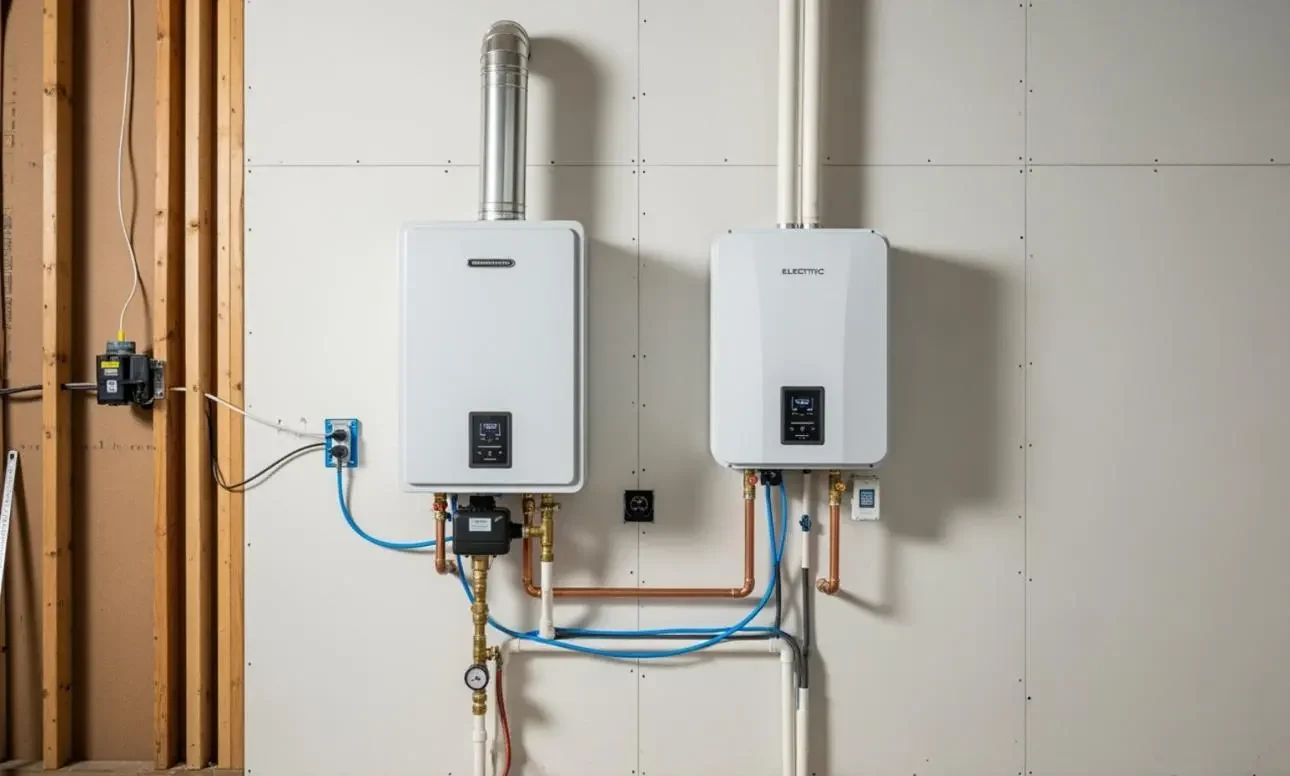
Gas and electric systems have different installation requirements.
| Factor | Gas Tankless | Electric Tankless |
|---|---|---|
| Energy source | Natural gas or propane | Electricity |
| Combustion venting | Required | Not required |
| Gas piping | Required | Not required |
| Electrical service | Usually required for controls and ignition | Large models may need several dedicated circuits |
| Large household demand | Many high-output options | Depends on electrical capacity and temperature rise |
| Installation concerns | Gas supply, venting, combustion air and condensate | Panel capacity, wiring and breakers |
Gas models often suit homes with high simultaneous hot-water demand. Electric systems can work well where electrical capacity is sufficient and the required flow is modest.
Compare local gas and electricity rates before choosing. The cheapest fuel to use depends on your utility costs and the unit’s efficiency.
Condensing vs. Non-Condensing Tankless Water Heaters
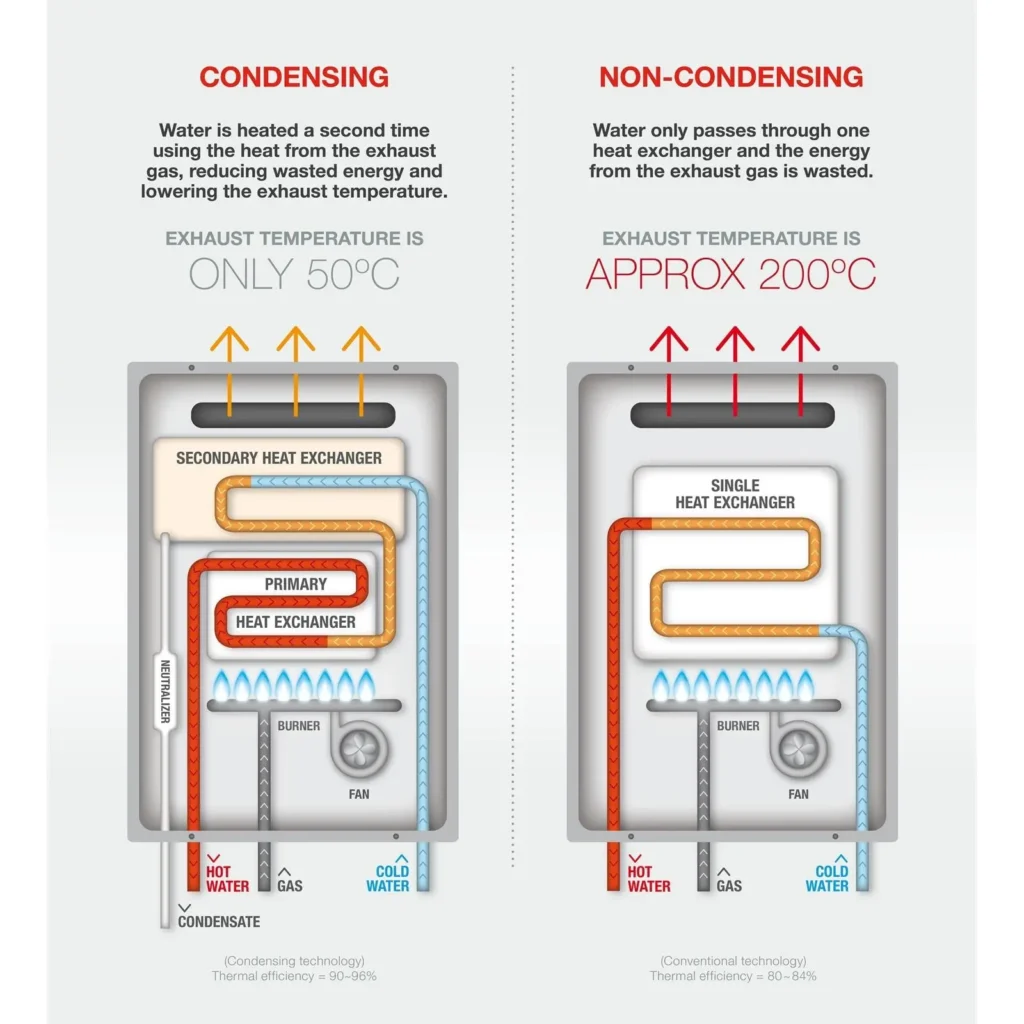
Condensing models recover additional heat from exhaust gases. They use a secondary heat exchanger to capture heat that would otherwise leave through the exhaust.
Non-condensing models use a simpler heat-recovery arrangement. Their exhaust is hotter, which affects venting materials and installation.
| Factor | Condensing | Non-Condensing |
|---|---|---|
| Exhaust heat recovery | Additional heat recovery | Less heat recovery |
| Efficiency | Generally higher | Generally lower |
| Condensate drainage | Required | Usually not required |
| Venting | Approved lower-temperature materials | Approved venting for hotter exhaust |
| Installation cost | Depends on drain and vent layout | Depends on vent material and route |
Compare the complete installed cost. A non-condensing heater may not be cheaper if the home needs a new vent.
Natural Gas vs. Propane Tankless Water Heaters
Natural gas is convenient where a utility connection is available. Propane can serve homes outside natural gas service areas.
The appliance must be approved for the selected fuel. Some models support field conversion, while others are sold in separate natural gas and propane versions.
Before ordering, confirm the fuel designation on the model number. Ask the installer to check the gas line, regulator and supply pressure. Propane tank capacity also needs to support the heater’s demand.
Indoor vs. Outdoor Tankless Water Heaters
Indoor gas heaters need approved venting and combustion air. Condensing models also need condensate drainage.
Outdoor units need an approved outdoor configuration. They must be protected from weather and freezing according to the manufacturer’s instructions.
Check the exact model’s installation manual before selecting a location. Leave enough space for service and maintenance.
Whole-House vs. Point-of-Use Tankless Water Heaters
A whole-house heater supplies multiple fixtures. Its capacity must match the home’s peak demand.
A point-of-use heater serves a nearby sink or small area. It can reduce the wait for hot water at a remote fixture, but it usually cannot replace a whole-house unit.
A home may use both. For example, a gas tankless heater could supply the main plumbing system while a small electric unit serves a distant sink.
What GPM Do You Need?
GPM measures the volume of water flowing through a fixture each minute. To size a tankless heater, add the flow rates of the fixtures that may operate together.
Use the actual flow rates of your showerheads and faucets. The figures below are examples, not fixed values for every home.
| Fixture | Example Flow |
|---|---|
| Shower | 2.0 GPM |
| Second shower | 2.0 GPM |
| Kitchen faucet | 1.5 GPM |
| Total | 5.5 GPM |
In this example, the heater needs to deliver 5.5 GPM at the required temperature rise if all three fixtures run together.
A product’s maximum GPM rating does not tell you whether it can maintain that output in winter.
Why Incoming Water Temperature Matters
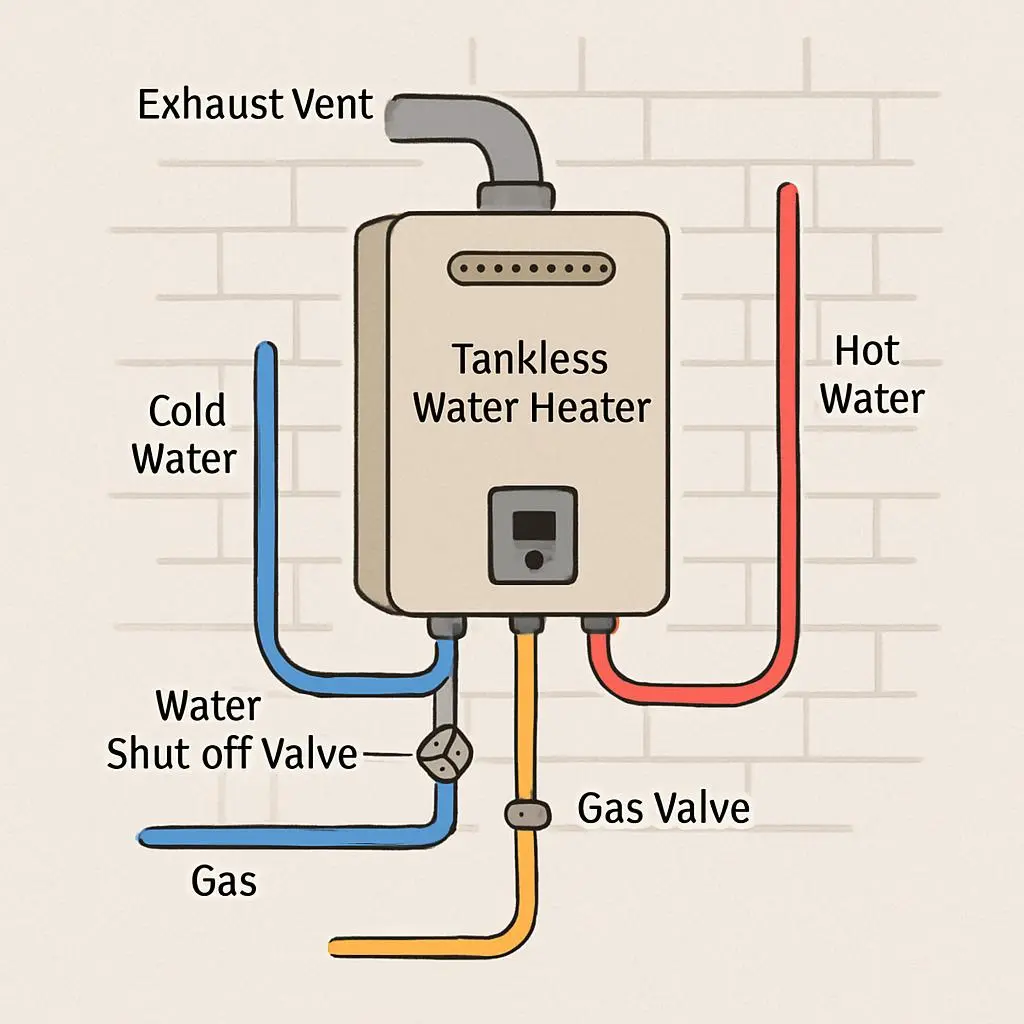
Temperature rise is the difference between the cold water entering the heater and the hot water leaving it.
Temperature rise = Desired outlet temperature − Incoming water temperature
For example, suppose you want 120°F water.
| Incoming Water | Required Temperature Rise |
|---|---|
| 70°F | 50°F |
| 60°F | 60°F |
| 50°F | 70°F |
| 40°F | 80°F |
The colder the incoming water, the more heating the unit must provide. Its available GPM generally decreases as the required temperature rise increases.
Use your winter inlet temperature when sizing the system. A summer calculation can lead to an undersized heater.
A Practical Sizing Example for Two Showers and a Kitchen Faucet
Suppose a household may run two showers and a kitchen faucet at the same time.
- Shower one: 2.0 GPM
- Shower two: 2.0 GPM
- Kitchen faucet: 1.5 GPM
- Combined demand: 5.5 GPM
Now assume incoming winter water is 50°F and the target outlet temperature is 120°F.
The required temperature rise is 70°F.
The Navien NPE-240A2 is listed at 5.6 GPM at a 67°F rise. That is close to the example’s 5.5 GPM demand, but the example requires a 70°F rise. The installer must use the manufacturer’s performance data at the actual design conditions before confirming suitability.
This calculation is a screening example. A professional should also check fixture flow, water pressure, pipe size and the heater’s minimum and maximum operating range.
What Do BTU and kW Tell You?
Gas tankless heaters use BTU per hour to describe heating input. Electric models use kilowatts.
A higher input rating generally allows more heating capacity. It does not guarantee a particular GPM at every temperature rise.
Compare the manufacturer’s performance chart. Look for the flow rate at your winter inlet temperature and desired outlet temperature.
What Is Minimum Activation Flow?
A tankless heater needs enough water flow to activate. If a fixture draws less than the unit’s minimum activation rate, the heater may not start reliably.
This matters with low-flow faucets, small sinks and some showerheads.
For example, Navien lists a 0.5 GPM minimum flow for the NPE-240A2 in its standard configuration. EcoSmart lists 0.3 GPM for the ECO 11.
Check this specification if you plan to use the heater with low-flow fixtures.
What Is Turndown Ratio?
A tankless heater adjusts its heating output as water demand changes. The turndown ratio describes the range between its maximum and minimum heating input.
A wider modulation range can help the unit respond to changing demand. Compare minimum input, maximum input and minimum activation flow together.
Do not use maximum BTU alone to judge how well a unit handles small water draws.
Does Low Water Pressure Affect a Tankless Water Heater?
It can. Tankless heaters need water to flow through the unit at a rate that activates the heating system.
Pressure and flow rate are different measurements. Pressure is commonly measured in PSI. Flow is measured in GPM.
A home may have acceptable pressure but restricted flow because of narrow pipes, clogged filters or plumbing restrictions. Check both before selecting a heater.
Best Tankless Water Heater Brands Compared
Brand reputation can help create a shortlist. The exact model, local service support and installation quality should guide the final choice.
Rinnai
Rinnai offers condensing and non-condensing gas models. The RXP199iN supports natural gas and propane, while the RE199iN is an indoor natural gas non-condensing option.
Compare the product’s performance chart, warranty, venting and recirculation features. Rinnai’s model range includes different capacities and installation configurations.
Visit the Rinnai official website for current residential models and product documents.
Navien
Navien’s NPE-A2 range includes condensing models with stainless steel heat exchangers. The NPE-240A2 includes ComfortFlow recirculation and supports field conversion to LP gas under the manufacturer’s instructions.
Check the recirculation configuration because warranty coverage can change with the installation.
Visit Navien’s official website for product specifications and warranty information.
Rheem
Rheem offers gas and electric water heaters. Its IKONIC condensing gas range includes models with different input ratings and configurations.
The ECOHS160iN has a listed 8.4 GPM rating and 0.96 UEF. The ECOHSR160iN adds a built-in recirculation pump.
Visit Rheem’s official website to compare current models and warranty documents.
Noritz
Noritz is another brand worth comparing for gas tankless systems. Check its current US product range, fuel type, flow at your required temperature rise, warranty and local service options.
Visit Noritz’s official website for current product information.
A. O. Smith
A. O. Smith sells several types of residential water-heating equipment, including tankless systems. Compare its current gas and electric models with the same criteria used for Rinnai, Navien and Rheem.
Also consider whether a conventional or heat pump water heater would better suit the home.
Visit A. O. Smith’s official website for product details.
Stiebel Eltron
Stiebel Eltron is a major option to consider for electric tankless water heating. Its Tempra range includes several power ratings.
The Tempra 29 Plus needs substantial electrical capacity. Check the manufacturer’s sizing chart before using it for a whole-house application.
Visit Stiebel Eltron USA for technical documents and sizing information.
EcoSmart
EcoSmart offers electric tankless models for different applications. The ECO 11 is a point-of-use model. Larger models have different capacities and electrical requirements.
Use the manufacturer’s sizing guide to select a model for the expected flow and temperature rise.
Visit EcoSmart’s official website for current product information.
Bosch and Takagi
Bosch and Takagi are additional names to include when comparing tankless products. Verify current US model availability and support before recommending a particular unit.
A useful comparison should include model specifications, warranty, replacement parts and local technician availability.
What Brand of Tankless Water Heater Is the Most Reliable?
There is no single reliability winner for every home. Reliability depends on the product, installation, water quality, maintenance and availability of service.
Ask local plumbing companies which brands they install and repair regularly. Find out whether they stock common replacement parts and how quickly they can obtain model-specific components.
Online homeowner discussions can help identify questions to ask. Treat individual reports as personal experiences, not proof of a brand-wide failure rate.
Which Is Better, Rheem or Navien?
Both manufacturers offer condensing gas systems. Navien’s NPE-240A2 includes built-in recirculation. Rheem’s IKONIC SR models also include a recirculation pump.
Compare the exact models on:
- Flow at the required temperature rise
- UEF
- Recirculation configuration
- Warranty conditions
- Gas and venting requirements
- Local service and parts availability
The better model is the one that meets the home’s demand and can be installed and maintained correctly.
How Much Does a Tankless Water Heater Cost?
The total cost includes the heater, labor and any required changes to the home’s gas, electrical or plumbing systems.
A straightforward replacement can cost less than a project that needs new venting, a larger gas line or an electrical service upgrade.
Equipment Prices
Equipment prices vary by model, fuel, capacity and retailer. Online prices can change and may differ by seller.
Check the exact model number before comparing prices. A listing for a standard Rheem IKONIC model may not include the same features as an SR recirculation model.
Ask whether the price includes valves, venting accessories or other required parts.
Professional Installation Costs
Installation may include:
- Removing the old heater
- Mounting the new unit
- Connecting water and fuel lines
- Installing approved venting
- Adding condensate drainage
- Installing electrical circuits
- Testing the system
- Obtaining permits and inspections
Get itemized quotes from qualified local installers. Ask each contractor to specify the exact model, installation materials and any required upgrades.
Gas Line and Meter Upgrades
A high-output gas model may need more fuel than the existing tank heater. The installer should calculate the total gas load and check the line size, length, pressure and meter capacity.
The calculation should include other gas appliances in the home. A model’s ability to connect to a particular pipe size under certain conditions does not mean the same pipe size will work in every home.
Electrical Upgrades
Large electric tankless heaters can require several dedicated circuits. The Tempra 29 Plus, for example, lists three 40-amp circuits at 240V.
Ask an electrician to inspect the panel and service before buying the unit. Include any wiring, breaker or panel upgrades in the total project budget.
Operating Costs and Energy Savings
Tankless systems avoid keeping a large storage tank hot throughout the day. That can reduce standby heat loss.
The US Department of Energy has reported that gas tankless water heaters can be 24% to 34% more energy-efficient than conventional storage water heaters in households using 41 gallons or less per day. For households using around 86 gallons daily, the reported improvement is 8% to 14%. Actual savings depend on usage and equipment.
Read the US Department of Energy’s guide to tankless water heaters for more information.
Compare your current energy use with the expected consumption of the replacement. Include recirculation electricity and maintenance when relevant.
Is a Tankless Water Heater Worth the Investment?
It may be worth considering if your household uses substantial hot water, wants a compact unit or can benefit from lower standby losses.
The higher initial cost can reduce the financial benefit. A home that needs major gas or electrical upgrades may take longer to recover the investment.
Compare the installed cost with expected annual energy savings. Use your actual utility rates rather than a national average.
Federal tax credit note: Under current IRS guidance, the federal Energy Efficient Home Improvement Credit under Section 25C does not apply to property placed in service after December 31, 2025. Check state and utility programs separately because their rules may differ.
Read the IRS guidance on the Section 25C credit before making a purchase based on tax incentives.
Tankless Water Heater Installation Requirements

Installation requirements depend on the fuel, model and location. A conventional tank heater’s existing connections may not be suitable for a tankless replacement.
Gas Line and Meter Capacity
High-output gas heaters can need a larger fuel supply than a conventional storage heater. The installer should calculate the total connected load and check the gas line and meter.
The calculation should include other gas appliances in the home. Follow the manufacturer’s installation manual and local fuel-gas code.
Electrical Panel and Circuit Requirements
Gas units need electricity for controls and ignition. Electric models need enough electrical service for their heating elements.
For example, the Tempra 29 Plus lists three 40-amp circuits at 240V. The ECO 11 lists a 60-amp double-pole breaker at 240V.
Have an electrician verify the panel, wiring and breakers before installation.
Venting and Combustion Air
Gas heaters need an approved venting arrangement and adequate combustion air. The permitted vent material, length and termination depend on the model.
Do not assume an existing tank heater vent can be reused. The installer should follow the manufacturer’s venting instructions and local mechanical and fuel-gas codes.
Condensate Drainage and Neutralization
Condensing gas heaters produce condensate. The installation may need a drain and neutralizer, depending on the product and local requirements.
The installer should confirm the correct disposal method. Poor drainage can cause damage or interfere with operation.
Indoor and Outdoor Installation Locations
Choose a location that meets the manufacturer’s clearance and access requirements. The unit needs enough space for inspection and maintenance.
Outdoor models need protection from weather and freezing. Use only approved outdoor configurations and accessories.
Freeze Protection
Cold weather can affect incoming water temperature and exposed plumbing. Some heaters include internal freeze protection, but exposed pipes may still freeze.
Follow the manufacturer’s instructions for insulation, power interruptions, draining and seasonal shutdowns.
Plumbing Pipe Diameter and Water Pressure
The water supply must provide enough flow and pressure for the heater and connected fixtures.
Undersized pipes, clogged filters and restrictive fittings can reduce flow. Ask the installer to check pipe sizing and pressure if the home has low-flow problems.
Professional Installation
Gas, electrical and venting work should follow applicable codes and manufacturer instructions. Poor installation can cause safety problems, unreliable operation and warranty disputes.
Ask for the permit and inspection details, startup checks and copies of the installation documents.
Tankless vs. Traditional Tank Water Heaters
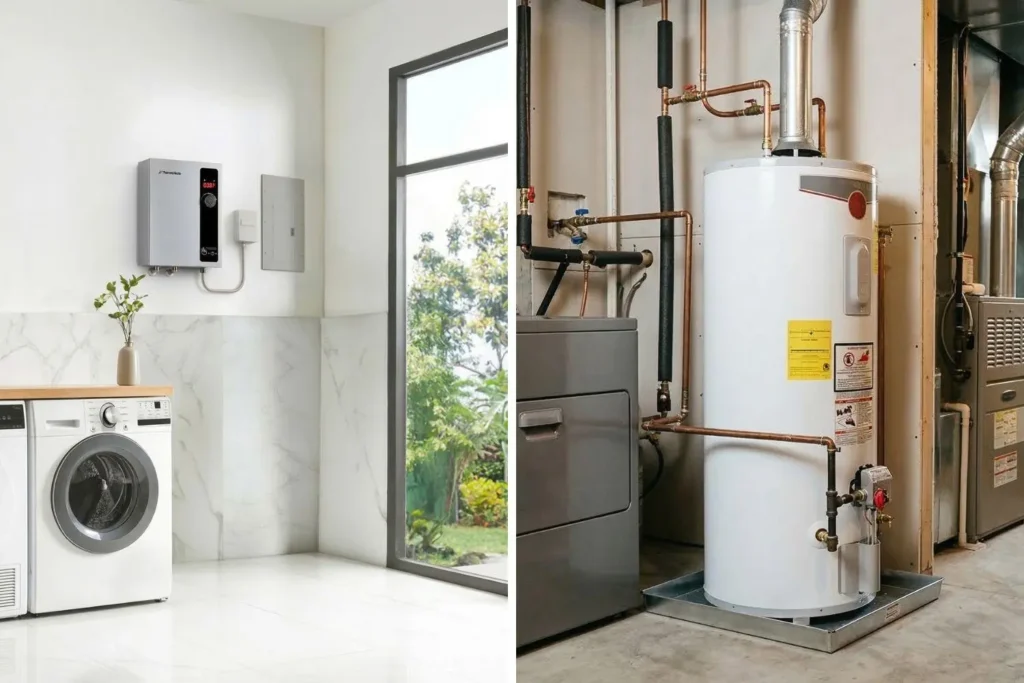
A tankless water heater heats water as it flows through the unit. A traditional tank heater stores hot water and reheats it as needed.
| Factor | Tankless | Traditional Tank |
|---|---|---|
| Hot-water supply | Limited by heating capacity and flow | Limited by stored volume and recovery |
| Standby heat loss | Lower | Present |
| Upfront cost | Often higher | Often lower |
| Installation | May require fuel, venting or electrical changes | Often simpler for like-for-like replacement |
| Space | Compact wall-mounted design | Larger storage tank |
| Maintenance | Descaling and filter checks | Sediment flushing and anode checks, depending on model |
Energy Efficiency
Tankless systems can reduce standby heat loss because they do not store a large volume of hot water. The savings depend on household usage and model efficiency.
If you are replacing an electric tank, also compare heat pump water heaters. They use a different technology and may offer another efficient option.
Hot-Water Availability
A properly sized tankless unit can provide continuous hot water while demand stays within its capacity.
A tank heater can run out of stored hot water during heavy use. It needs time to recover after the tank is depleted.
Purchase and Installation Cost
Tankless systems often cost more to install, especially when the home needs gas, venting or electrical changes.
A conventional tank replacement may be simpler. Compare the full installed cost of each system.
Lifespan and Maintenance
Tankless heaters can provide many years of service when installed and maintained correctly. Actual lifespan depends on water quality, usage and maintenance.
Tank models also need maintenance. Check the manufacturer’s guidance for sediment flushing and anode rod inspection.
Which System Should You Choose?
A tankless system may suit a home that wants a compact heater and has the infrastructure to support it. A traditional tank may suit a homeowner who wants a simpler replacement and lower initial cost.
Compare heat pump water heaters if your home uses electricity and you want to assess other efficiency options.
Tankless Water Heater Maintenance and Common Problems
Maintenance requirements depend on the model and water quality. Hard water can increase mineral buildup inside the heat exchanger.
How Often Should You Flush a Tankless Water Heater?

Follow the maintenance schedule in the model’s manual. Navien recommends annual descaling for its tankless models, with more frequent maintenance possible in some water conditions.
Rinnai also provides model-specific maintenance instructions. Check its manual for flushing and inlet filter cleaning.
Do not use a universal flushing schedule for every brand and model.
Hard Water and Mineral Buildup
Hard water contains dissolved minerals, mainly calcium and magnesium. Heating can cause mineral deposits to build up inside the heat exchanger.
Scale can restrict water flow and reduce heat transfer. It may also contribute to noise or operating problems.
Test your water if you do not know its hardness. Ask the manufacturer or installer whether a softener or scale-control system is suitable.
Water Softeners and Sediment Filters
A water softener reduces hardness minerals. A sediment filter catches particles.
They serve different purposes. A sediment filter does not remove dissolved calcium and magnesium.
Check the water heater’s water-quality requirements before adding treatment equipment. Follow the manufacturer’s instructions to protect the warranty.
Cleaning the Inlet Filter
Many tankless heaters include an inlet filter that catches debris. A clogged filter can restrict water flow.
Follow the manual before removing or cleaning the filter. Shut off the appropriate water supply and use the manufacturer’s procedure.
Freeze Protection and Winter Maintenance
Insulate exposed water lines where required. Follow the heater’s freeze-protection instructions, especially during power outages or long periods when the home is vacant.
Some systems need to be drained under certain conditions. Ask a qualified technician if you are unsure how to prepare the unit for freezing weather.
Common Tankless Water Heater Problems
| Problem | Possible Cause |
|---|---|
| Low hot-water flow | Clogged filter, scale or pipe restriction |
| Temperature changes | Demand exceeds capacity or flow changes |
| Heater does not activate | Flow below minimum activation rate |
| Error code | Ignition, sensor, venting, fuel or electrical issue |
| Long wait for hot water | Long pipe run or no recirculation arrangement |
| Poor winter performance | Lower inlet temperature or frozen plumbing |
| Frequent maintenance | Hard water or heavy usage |
Use the manufacturer’s troubleshooting guide. Have a qualified technician inspect gas, electrical and combustion issues.
Which Tankless Water Heater Is Right for Your Home?
Use your household demand and available infrastructure to narrow the choices.
| Household or Installation Situation | Models or Category to Investigate | Main Point to Verify |
|---|---|---|
| High-demand gas household | Rinnai RXP199iN, Navien NPE-240A2 | Flow at winter temperature rise |
| Built-in recirculation | Navien NPE-240A2, Rheem IKONIC SR | Pump configuration and plumbing layout |
| Non-condensing gas preference | Rinnai RE199iN | Venting and installed cost |
| Mid-capacity gas demand | Rheem ECOHS160iN | Flow at required temperature rise |
| Whole-house electric candidate | Stiebel Eltron Tempra 29 Plus | Electrical service and cold-water output |
| Small sink or limited use | EcoSmart ECO 11 | Point-of-use flow and electrical capacity |
| Propane home | Approved propane model | Tank, regulator and gas-line capacity |
| Hard-water area | Suitable model with water treatment plan | Maintenance schedule and warranty |
| Cold climate | High-capacity model selected from winter data | Temperature rise and freeze protection |
For Large Families and Multiple Bathrooms
Calculate the fixtures likely to run together. Compare the total GPM with the model’s output at the coldest expected inlet temperature.
High-capacity gas models may be suitable, but a single unit will not meet every large home’s demand. Some homes may need compatible multiple units.
For Small Homes and Apartments
A smaller whole-house model may work if the demand is modest. A point-of-use heater may help with a distant sink.
Check building rules, electrical capacity and the distance between the heater and fixtures.
For Natural Gas Homes
Compare natural gas models from Rinnai, Navien, Rheem and Noritz. Look at UEF, temperature-rise performance, venting and local repair support.
For Propane Homes
Choose a model approved for propane. Confirm the exact version or approved conversion procedure.
Check the propane tank and regulator capacity. The system must supply enough fuel when other gas appliances operate.
For All-Electric Homes
Check the electrical panel before considering a whole-house electric tankless heater. The Tempra 29 Plus requires three 40-amp circuits at 240V.
A point-of-use model may be more practical for a single sink or limited application.
For Cold Climates
Use winter incoming water temperature when sizing. A heater that performs well in summer may deliver much less flow during winter.
Check the manufacturer’s performance table at the required temperature rise. Also review freeze-protection requirements for exposed plumbing.
For Hard-Water Areas
Test the water and check the manufacturer’s requirements. Budget for descaling or suitable water treatment if needed.
A water softener may help reduce hardness minerals. A sediment filter alone does not solve hard-water scale.
For Buyers on a Limited Budget
Compare the complete installed price. Include the heater, labor, venting, valves, electrical work, gas-line changes and permits.
A low-cost point-of-use model may be suitable for one sink. It should not be treated as a low-cost replacement for a whole-house system.
Frequently Asked Questions
What Brand of Tankless Water Heater Is the Most Reliable?
There is no universal reliability winner. Compare the exact model’s warranty, service network, replacement parts and maintenance requirements. Ask local installers which brands they regularly service.
Which Is Better, Rheem or Navien?
Both offer condensing gas tankless systems. Navien’s NPE-240A2 includes built-in recirculation. Rheem’s IKONIC SR models include a recirculation pump. Compare their flow charts, warranty terms and local service support.
What Size Tankless Water Heater Do I Need for a 2,000-Square-Foot House?
Floor area alone cannot determine heater size. Calculate simultaneous fixture demand and the required temperature rise. A 2,000-square-foot home with one bathroom may need a different capacity from a home of the same size with three bathrooms.
What Are Two Disadvantages of a Tankless Water Heater?
The main disadvantages are higher upfront installation costs and limited flow capacity. Some homes also need gas-line, venting or electrical upgrades. Regular maintenance adds another ownership cost.
What Water Heater Do Plumbers Recommend?
Recommendations vary by region and service experience. Ask a licensed plumber to compare models they can install and repair locally. Request the performance chart, warranty and an itemized installation quote.
Does a Tankless Water Heater Provide Instant Hot Water?
The heater begins heating water when it detects flow. Hot water still needs time to travel through the pipes. A long distance between the heater and tap can create a delay. A suitable recirculation system can reduce that wait.
Can a Tankless Water Heater Run Three Showers at Once?
Yes, if its output meets the combined flow at the required temperature rise. Three showers may exceed a single unit’s capacity, especially when incoming water is cold. Check the manufacturer’s performance chart.
How Long Do Tankless Water Heaters Last?
Service life depends on installation, water quality, usage and maintenance. Check the exact model’s warranty and service requirements. Keep records of flushing and repairs.
How Often Should a Tankless Water Heater Be Flushed?
Follow the manufacturer’s schedule. Navien recommends annual descaling for its models, while water conditions can affect the required interval. Check your unit’s manual before scheduling service.
What Temperature Should a Tankless Water Heater Be Set To?
Many homes use a setting around 120°F, but household needs and plumbing design can differ. Higher temperatures increase scalding risk. Follow the manufacturer’s instructions and consider an anti-scald mixing valve where appropriate.
Final Recommendation: Which Tankless Water Heater Should You Buy?
The Rinnai SENSEI RXP199iN is a strong high-efficiency gas candidate. It has a 0.98 UEF, supports natural gas and propane, and lists a maximum flow of 11.1 GPM. Check its output at your winter temperature rise before choosing it.
The Navien NPE-240A2 is worth comparing if built-in recirculation is important. Its published performance chart makes it possible to compare output across several temperature rises.
Rheem’s IKONIC ECOHS160iN is another condensing gas option. Its 8.4 GPM rating and 0.96 UEF make it worth considering for homes whose demand fits its actual performance.
For electric heating, the Stiebel Eltron Tempra 29 Plus offers high output but needs substantial electrical capacity. The EcoSmart ECO 11 is intended for smaller point-of-use applications.
Before ordering, have an installer calculate peak demand and check winter inlet temperature, gas or electrical capacity, venting and local code requirements. Ask for a written quote that identifies the exact model and all installation work.