

How Much Is Concrete Per Yard in 2027? (Ready-Mix Prices, Delivery & Costs)
Ready-mix concrete costs vary by location, mix strength, order size, and delivery terms. Current U.S. cost guides show a broad range, with some listing base prices around $119–$147 per cubic yard and others reporting $160–$195 or more. These figures are not directly comparable because sources use different pricing methods and may treat delivery charges differently.
For a useful estimate, check the price per cubic yard, then add short-load fees, delivery charges, and any requested additives. Also separate the cost of buying concrete from the cost of having a contractor prepare, pour, and finish it.
This guide compares 2027 pricing examples, explains what changes the final bill, and shows how to calculate the concrete your project needs.
How Much Does Concrete Cost Per Cubic Yard in 2027
A cubic yard of ready-mix concrete can cost roughly $119–$195 or more, depending on the source, location, mix, and delivery conditions. Treat this as a broad budgeting range rather than a guaranteed supplier price.
For context, Concrete Network, updated July 14, 2027, reports a nationwide range of $160–$195 or more per cubic yard. It also cites a 2025 national ready-mix average of $179.95 per cubic yard.
HomeGuide lists a lower base range of $119–$147 per cubic yard. Its guide also lists additional charges for short loads, Saturday delivery, and other options. These estimates should not be averaged together because their pricing assumptions differ.
What Is the Average Price of Concrete Per Yard?
There is no single price that applies to every U.S. concrete order. A supplier near a batch plant may quote less than a supplier serving a remote job site. A small residential order may also cost more per yard than a full truckload.
Use these published figures as reference points:
| Pricing reference | Price per cubic yard | Important details |
|---|---|---|
| HomeGuide base-price range | $119–$147 | Additional delivery and order charges may apply |
| Concrete Network national range | $160–$195+ | Guide updated July 14, 2027 |
| Concrete Network 2025 average | $179.95 | Historical national average cited in its 2027 guide |
| Superior Ready Mix standard residential mix | $130–$150 | Supplier example for Southern California |
| American Concrete 3,000 PSI COD price | $174 | Supplier price list effective April 1, 2027 |
These are different types of pricing evidence. Some are national cost-guide estimates, while others come from individual suppliers. Use a local written quote for your actual project.
What Is Included in the Price Per Cubic Yard?
A supplier’s listed price may cover only the concrete mix. Another supplier may include delivery within a certain distance. Some charge delivery, short-load fees, and other extras separately.
Before comparing prices, identify which of these three costs the supplier is quoting:
| Cost type | What it means |
|---|---|
| Material-only price | The concrete mix price before separate delivery or service charges |
| Delivered price | The concrete plus the delivery charges included in the quote |
| Installed price | The complete project cost, including preparation, materials, labor, pouring, and finishing |
For example, American Concrete lists a 3,000 PSI cash-on-delivery price of $174 per cubic yard. Its price sheet separately lists an $85 delivery charge for deliveries under six cubic yards, subject to its stated terms.
That means the listed per-yard rate alone does not tell you the final invoice. Ask the supplier for the total delivered price before placing your order.
What Is a Cubic Yard of Concrete?

A cubic yard is a unit of volume. It measures a space that is 3 feet long, 3 feet wide, and 3 feet high.
One cubic yard contains 27 cubic feet. Concrete suppliers use this measurement because concrete orders depend on volume, not just the surface area of a slab.
A 100-square-foot slab needs different amounts of concrete at different thicknesses. That is why you must calculate length, width, and depth before ordering.
How Much Is Concrete Per Yard by PSI and Mix Type?

Concrete prices can change with the required mix design and strength. PSI means pounds per square inch. It measures concrete’s compressive strength.
A higher PSI specification may cost more, but PSI is not the only factor. Aggregate size, cement content, admixtures, air requirements, and supplier pricing also affect the mix.
How Much Does 2,500–3,000 PSI Concrete Cost Per Yard?
A 2,500–3,000 PSI mix is a common residential pricing category. Suppliers may offer different rates based on the mix design and the project specification.
Superior Ready Mix lists approximate Southern California prices of $130–$150 per cubic yard for standard residential mixes in the 2,500–3,000 PSI range. This is a regional supplier example, not a nationwide rate.
How Much Does 3,500–4,000 PSI Concrete Cost Per Yard?
Higher-strength mixes can carry a higher price. The actual difference depends on the supplier’s mix design and the specifications required for the job.
American Concrete’s published price list provides one useful comparison:
| Mix strength | Cash-on-delivery price | Contractor price |
|---|---|---|
| 2,500 PSI | $170/yd³ | $160/yd³ |
| 3,000 PSI | $174/yd³ | $164/yd³ |
| 4,000 PSI | $182/yd³ | $172/yd³ |
These prices are from American Concrete’s list effective April 1, 2027. Contractor rates apply to eligible customers with an open account. The figures do not represent a national price schedule.
How Much Does 4,500–5,000 PSI Concrete Cost Per Yard?
Higher-strength concrete is often specified for projects with greater structural or load requirements. Its price depends on the supplier’s materials, mix design, and production requirements.
Superior Ready Mix lists approximately $145–$170 per cubic yard for structural and commercial mixes in the 4,000–5,000 PSI range. Confirm the exact mix and price with the supplier before comparing it with a standard residential mix.
Do not choose a PSI rating only because it appears cheaper. Follow the construction plans, applicable building requirements, and recommendations from the qualified professional responsible for the project.
Does 6,000 PSI Concrete Cost More Per Yard?
A 6,000 PSI mix may cost more than a standard residential mix, but there is no reliable universal rate for it in the supplied supplier price lists. Ask local plants for a quote based on the exact specification.
The same applies to other specialty mixes. A supplier needs to know the required strength, exposure conditions, aggregate size, and any additional mix requirements.
How Much Do Fiber, Colored, and Specialty Concrete Mixes Cost?
Specialty options can increase the base price. The amount depends on the additive and how the supplier prices it.
Examples from published supplier information include:
- Fiber reinforcement: American Concrete lists residential fiber at $4 per cubic yard and commercial fiber at $6.25 per cubic yard.
- Small-stone mix: American Concrete lists an additional $8 per cubic yard for certain small-stone concrete.
- Coloring: Superior Ready Mix lists colored concrete at approximately $155–$185 or more per cubic yard in its Southern California pricing examples.
- Retarder: American Concrete lists $2.50 per cubic yard.
- Superplasticizer: American Concrete lists $5.50 per cubic yard.
These are supplier-specific charges. Other plants may use different rates or include some additives in the mix price.
Concrete is made from hydraulic cement, aggregates, and water. Mixes may also include fibers, admixtures, and other cementitious materials. The American Concrete Institute’s concrete definition explains these basic components.
How Much Is Concrete Per Yard in Different Parts of the United States?
Concrete prices vary across the country. Local material supply, transportation distance, plant competition, order volume, and delivery conditions all affect the quote.
A supplier close to your project may offer a lower delivered price than a plant located farther away. Large metropolitan areas may also have different operating costs from smaller markets.
Why Do Concrete Prices Differ by Region?
Several factors can change your local price:
- Batch plant distance: Longer trips can increase delivery charges.
- Local supplier competition: More nearby suppliers may give buyers more pricing options.
- Aggregate availability: Sand, gravel, and crushed stone supply can affect local production costs.
- Labor and operating costs: Regional business costs can influence supplier pricing.
- Order volume: Larger orders may receive different rates.
- Season and scheduling: Busy periods can affect availability and delivery terms.
The U.S. Bureau of Labor Statistics tracks producer prices for ready-mix concrete. Its Producer Price Index is useful for following price movement over time, but it is an index, not a retail price per cubic yard. Check the BLS Producer Price Index for updated data.
What Do Regional Supplier Prices Look Like?
Concrete Network reports these market examples in its 2027 pricing guide:
| Market | Average price per yard | Typical reported range |
|---|---|---|
| Chicago, Illinois | $183 | $170–$210 |
| Los Angeles, California | $182 | $170–$200 |
| Lynchburg, Virginia | $165 | $150–$180 |
The source notes that some supplier quotes included delivery or short-load fees. The examples are useful for comparing markets, but they are not a complete price survey of every state.
Individual supplier prices can also differ within the same region. For example, Superior Ready Mix publishes lower standard residential ranges for its Southern California service area. Mix strength, order conditions, and delivery terms must match before comparing supplier rates.
How Can You Find the Price of Concrete Near You?
Start with two or three ready-mix suppliers that serve your project address. Give each supplier the same information so you can compare their quotes fairly.
Tell them:
- Your delivery address or ZIP code.
- The number of cubic yards you need.
- The required PSI and mix specifications.
- Your preferred delivery date and time.
- Whether the truck can reach the pour location.
- Whether you need fiber, color, or another additive.
Ask each supplier for the total delivered cost, not only the advertised price per yard.
What Extra Fees Affect the Delivered Price of Concrete?
Delivery and order charges can make a noticeable difference, especially for small projects. A low advertised price may become much higher once the supplier adds transportation and minimum-order fees.
What Is a Short-Load Fee?
A short-load fee applies when you order less than the supplier’s preferred or minimum truck quantity. The supplier still has to dispatch a truck, even when it carries only a small amount of concrete.
Many standard mixer trucks carry roughly 8–10 cubic yards, although truck sizes and supplier rules vary. Some plants set minimum quantities below a full truckload.
Here are examples of published charges:
| Supplier or pricing guide | Example charge |
|---|---|
| HomeGuide | Adds $53 per cubic yard for orders under 10 cubic yards |
| American Concrete | Lists an $85 delivery charge for orders under six cubic yards, subject to its terms |
| American Concrete | Lists a minimum COD purchase of $820 for 3,000 PSI orders of four cubic yards or less |
These examples are not universal rules. One supplier may use a flat delivery charge, while another may add a fee to every yard in a short load.
Ask the plant how it calculates the charge. A $100 fee on a one-yard order has a much larger effect per yard than the same fee on a five-yard order.
How Much Does Concrete Delivery Cost?
Delivery may be included in a supplier’s quoted yard price or billed separately. The charge often depends on distance, order size, and the supplier’s service area.
HomeGuide lists a full-load delivery charge of $55–$65 in its delivery guide. American Concrete lists an $85 charge on deliveries under six cubic yards, subject to its published conditions.
Ask whether the supplier also charges for:
- Fuel or mileage.
- Deliveries outside its usual radius.
- Additional trucks.
- Special delivery windows.
- Minimum order quantities.
- Taxes and other local charges.
Do not assume a supplier’s delivery terms are the same as another plant’s terms.
Can Weekend Delivery and Waiting Time Increase the Price?
Some plants charge more for Saturday or special-time deliveries. Truck waiting time can also add to the bill when the crew is not ready to unload.
American Concrete allows one hour for unloading under its published price terms. It lists an additional $75 per hour after that time.
Prepare the site, forms, tools, and crew before the truck arrives. Confirm the supplier’s unloading allowance and waiting-time rate when booking.
When Do You Need a Concrete Pump?
A concrete pump may be necessary when a mixer truck cannot reach the pour location with its chute. This can happen when the slab is behind a building, inside a basement, or far from the driveway.
Line pumps and boom pumps are common options. The right type depends on the distance, height, access, and amount of concrete.
Pumping is a separate service in many quotes. Ask for the pump charge, minimum fee, setup cost, and any additional hourly rate before scheduling.
What Factors Affect Concrete Price Per Yard?
The price per yard reflects more than the amount of cement in the mix. Suppliers consider materials, specifications, order volume, production requirements, and delivery conditions.
How Does Concrete Mix Design Affect the Price?
Concrete combines cement, water, fine aggregate, and coarse aggregate. Cement and water form a paste that binds the aggregates together.
The American Cement Association explains that cement is an ingredient in concrete, not another name for the finished material.
A supplier adjusts the mix to meet the project’s requirements. These requirements may include compressive strength, aggregate size, workability, exposure conditions, and curing needs.
Portland cement is a common binder. Some mixes also use fly ash, other cementitious materials, or chemical admixtures. These ingredients can change the mix properties and the quoted price.
Does Ordering More Concrete Reduce the Price Per Yard?
Order volume can affect the price. A full truckload often costs less per yard than a small order because the supplier can use its truck capacity more efficiently.
Some suppliers also offer contractor rates or negotiate pricing for large orders. American Concrete, for example, publishes separate contractor prices for customers with open accounts and states that pricing may be negotiated for large-volume orders.
Ask whether a larger order changes the base rate, delivery fee, or minimum charge. Do not order more concrete than the project needs simply to chase a lower unit price.
How Do Additives and Reinforcement Affect Concrete Prices?
Additives change how concrete behaves during mixing, placement, or curing. Some improve workability, while others affect setting time or other mix properties.
Common examples include:
- Fiber reinforcement: Adds fibers to the concrete mix.
- Air-entraining admixtures: Introduce controlled air bubbles where the mix specification requires them.
- Retarders: Slow the setting process.
- Accelerators: Help speed up setting or early strength development.
- Water reducers: Improve workability without adding the same amount of extra water.
- Fly ash and other cementitious materials: Can replace part of the Portland cement in certain mix designs.
Steel reinforcement, rebar, and wire mesh are often separate project materials. They should not be assumed to be included in the ready-mix price.
Can Weather and Scheduling Affect Concrete Costs?
Weather can affect when concrete is poured and what the mix requires. Hot conditions may call for scheduling changes or suitable admixtures. Cold conditions may require extra precautions to protect fresh concrete.
Busy seasons can also limit truck availability. Ask the supplier whether your delivery date carries a surcharge or special handling requirement.
How Much Will 1 Yard of Concrete Cover?
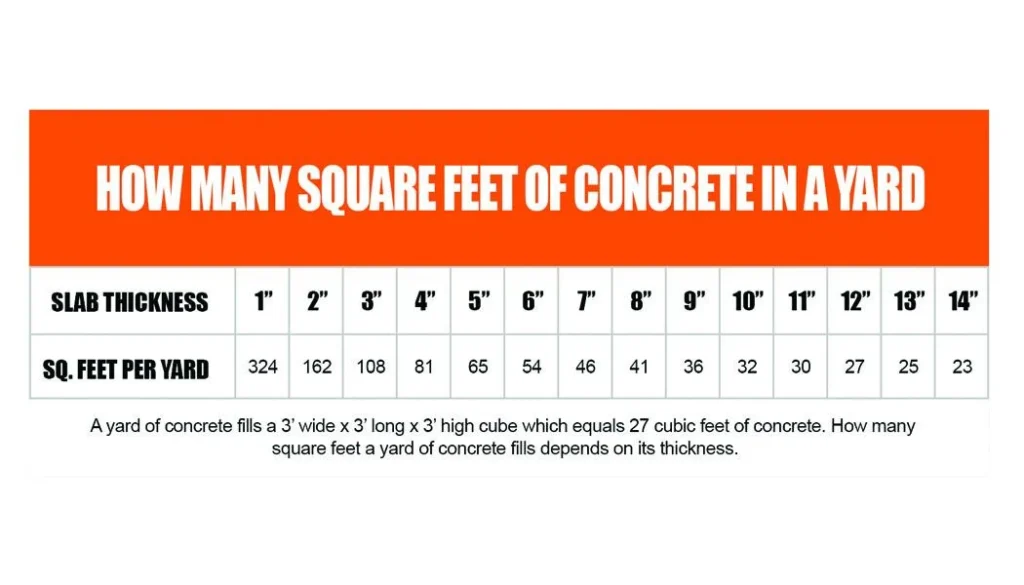
One cubic yard covers approximately 81 square feet at four inches thick. The coverage decreases as the slab gets thicker because the same volume must fill a deeper space.
Use this table for quick planning:
| Slab thickness | Approximate coverage from one cubic yard |
|---|---|
| 4 inches | 81 sq. ft. |
| 5 inches | 65 sq. ft. |
| 6 inches | 54 sq. ft. |
These figures assume a uniform slab thickness. Uneven ground, forms, slopes, and waste can change the amount you need.
How Much Area Does One Yard Cover at 4 Inches?
At four inches thick, one cubic yard covers approximately 81 square feet. This is a common reference point for basic residential slab calculations.
For example, a 9-foot by 9-foot area has 81 square feet of surface area. At four inches thick, it needs about one cubic yard before adding a waste allowance.
How Much Area Does One Yard Cover at 5 or 6 Inches?
A five-inch slab covers about 65 square feet per cubic yard. A six-inch slab covers about 54 square feet.
A thicker slab needs more concrete for the same surface area. That increases the material quantity and can raise the total order cost.
How Many Bags of Concrete Equal One Cubic Yard?
The number of bags depends on their weight and the product’s stated yield. QUIKRETE’s published data sheet gives these approximate yields:
| Bag size | Approximate yield | Bags for one cubic yard |
|---|---|---|
| 40 lb | 0.30 cu. ft. | 90 |
| 50 lb | 0.375 cu. ft. | 72 |
| 60 lb | 0.45 cu. ft. | 60 |
| 80 lb | 0.60 cu. ft. | 45 |
| 90 lb | 0.675 cu. ft. | 40 |
One cubic yard contains 27 cubic feet. For an 80-pound bag, divide 27 by 0.60 to get 45 bags.
These numbers use QUIKRETE’s listed yields. Check the yield on the exact bag you plan to buy because products can differ. See the QUIKRETE Concrete Mix data sheet.
How Do You Calculate How Many Cubic Yards of Concrete You Need?
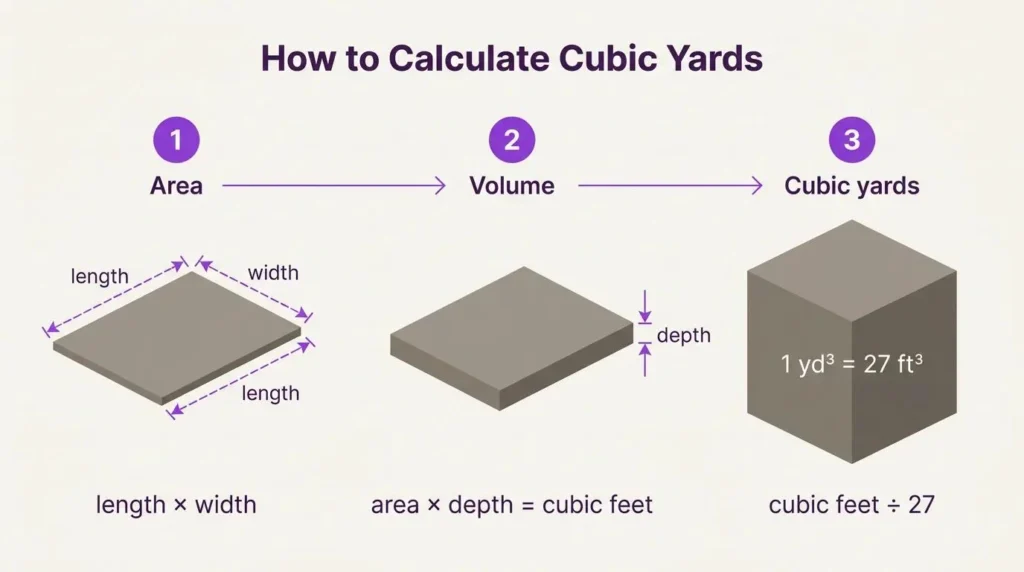
First, calculate your project’s surface area using our square foot calculator. Then use the slab’s thickness to calculate how many cubic yards of concrete you need.
You can calculate concrete volume with three measurements: length, width, and thickness. Convert every measurement to feet before using the formula.
What Is the Formula for Calculating Cubic Yards of Concrete?
Use this formula:
Cubic yards = (Length × Width × Thickness) ÷ 27
Measure length and width in feet. Convert thickness from inches to feet first.
For example, four inches equals 4 ÷ 12, or 0.333 feet. After multiplying the three measurements, divide the cubic feet by 27 to get cubic yards.
How Much Concrete Does a 10×10 Slab Need?
A 10×10-foot slab has 100 square feet of area. At four inches thick, the calculation is:
- Length: 10 feet
- Width: 10 feet
- Thickness: 4 ÷ 12 = 0.333 feet
- Volume: 10 × 10 × 0.333 = 33.3 cubic feet
- Cubic yards: 33.3 ÷ 27 = approximately 1.23 cubic yards
Add a waste allowance before ordering. With an extra 5–10%, the order would be approximately 1.29–1.36 cubic yards.
How Much Concrete Does a 20×20 Slab Need?
A 20×20-foot slab has 400 square feet of area. At four inches thick, it needs approximately 4.94 cubic yards before waste.
| Calculation | Result |
|---|---|
| Slab area | 400 sq. ft. |
| Thickness | 4 inches |
| Concrete volume | 133.3 cu. ft. |
| Required quantity | 4.94 cu. yd. |
| With 5% extra | 5.19 cu. yd. |
| With 10% extra | 5.43 cu. yd. |
Now estimate the material cost using a supplier’s quoted rate. For illustration, at American Concrete’s published 3,000 PSI COD rate of $174 per cubic yard, 5.19–5.43 cubic yards would cost about $903–$945 before any applicable delivery or other charges.
This is only an example using one supplier’s published price. Your local rate and order terms may differ.
How Much Extra Concrete Should You Order?
Many cost guides recommend adding around 5–10% to cover waste, spills, and uneven ground. The right allowance depends on the accuracy of your measurements and site conditions.
Check the subgrade before ordering. Low spots or uneven thickness can increase the volume. Ask your contractor or supplier to review the calculation if the pour has complicated shapes, slopes, or footings.
A concrete shortage during a continuous pour can create delays and an unwanted joint. It is usually better to confirm the order quantity before the truck leaves the plant.
How Much Does Concrete Cost for a Finished Slab?
The price of ready-mix concrete is only one part of a finished slab. A contractor’s price may include site preparation, base material, forms, reinforcement, placement, finishing, and cleanup.
Concrete Network reports a plain poured concrete slab range of approximately $6.50–$10.50 per square foot. HomeGuide lists approximately $5–$10 per square foot for installed concrete. These are broad guide estimates, not quotes for a specific property.
What Is the Difference Between Concrete Material Cost and Installed Cost?
The material price tells you what the concrete itself costs. An installed quote covers the work needed to prepare the site and complete the slab.
A contractor may include:
- Excavation and grading.
- Gravel or crushed-stone subbase.
- Formwork and stakes.
- Rebar or wire mesh.
- Concrete delivery.
- Pumping, if required.
- Placement and screeding.
- Broom or decorative finishing.
- Cleanup and disposal.
Ask whether your quote includes all these items. A lower price per square foot may leave out preparation or reinforcement that another contractor includes.
How Much Does a Concrete Patio or Sidewalk Cost?
A small patio or sidewalk may need only a few cubic yards, but the final price depends on access, thickness, base preparation, finish, and delivery minimums.
For a small job, a short-load fee can increase the delivered cost per yard. Compare the total price of bagged concrete, ready-mix delivery, and any on-site mixing option before deciding.
How Much Does a Concrete Driveway or Garage Floor Cost?
Driveways and garage floors may need different thicknesses, mix specifications, and reinforcement. Vehicle weight, soil conditions, drainage, and local requirements can also affect the design.
Do not use a generic PSI figure or thickness without checking the project specification. Ask the contractor to state the concrete grade, thickness, reinforcement, base preparation, and finishing method in the estimate.
Does Concrete Labor Cost Per Yard or Per Square Foot?
Concrete suppliers usually sell the material by the cubic yard. Contractors may quote installation by the square foot, by the project, or through a detailed estimate.
Labor is not automatically included in a concrete supplier’s price per yard. Check how the contractor calculates labor and whether it includes forming, placement, finishing, and equipment.
Is Ready-Mix Concrete Cheaper Than Bagged or Volumetric Concrete?
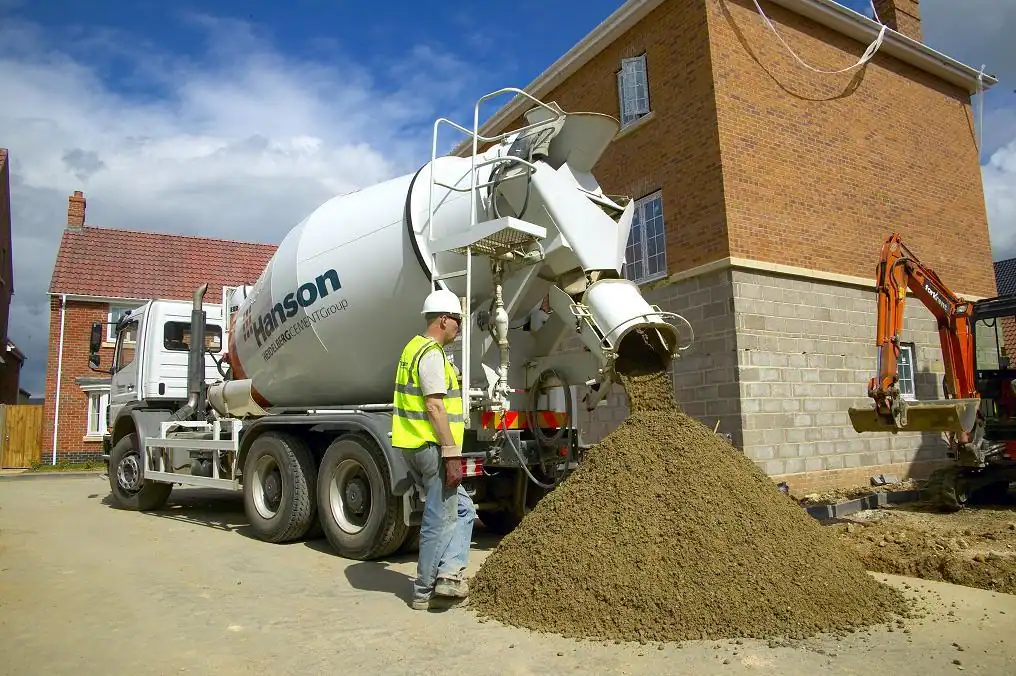
The best option depends on how much concrete you need, where the truck can reach, and the supplier’s minimum order charges.
Ready-Mix Concrete vs. Bagged Concrete
Bagged concrete can be practical for small repairs and projects that need only a small amount. You can buy the bags locally and mix them with water as needed.
Ready-mix concrete is often more practical for larger pours. A single cubic yard requires about 45 bags of 80-pound QUIKRETE mix based on its published yield. Mixing that many bags takes substantial time and effort.
Compare the full costs:
| Cost consideration | Bagged concrete | Ready-mix concrete |
|---|---|---|
| Purchase method | Buy individual bags | Order by cubic yard |
| Mixing | Mix on site | Delivered from a batch plant |
| Best fit | Small repairs and limited volumes | Larger slabs and continuous pours |
| Extra costs | Mixer rental, tools, and labor | Delivery, short-load, and waiting fees |
| Quantity control | Buy bags in set increments | Order the required cubic yards |
To compare accurately, multiply the number of bags by the local price per bag. Then add any mixer rental and labor costs. For ready-mix, add the quoted delivery and short-load fees to the base material cost.
There is no universal break-even point. A small order with a high delivery minimum may favor bags, while a larger pour may favor ready-mix.
Ready-Mix Concrete vs. Volumetric Concrete
A volumetric truck carries separate concrete ingredients and mixes them at the job site. This can help when the required quantity is uncertain or the project needs a smaller delivery.
Traditional ready-mix arrives mixed from the batch plant. It is commonly used for larger pours where the required volume is known and the site is ready for delivery.
Ask suppliers about minimum quantities, mix options, time charges, and whether they charge for unused material. Compare the final quote rather than the advertised per-yard rate.
Which Concrete Option Is Better for Small and Large Projects?
Bagged concrete may suit fence posts, small patches, and limited repairs. Ready-mix is often more efficient for patios, driveways, garage slabs, and other larger pours.
Volumetric delivery may be worth comparing when you need a flexible quantity or want concrete mixed on site. The right choice depends on local availability and the complete price.
How Can You Compare Concrete Suppliers and Get an Accurate Quote?
A supplier’s advertised price is only a starting point. Get a written quote that states the mix, quantity, delivery terms, and all extra charges.
What Should You Ask a Ready-Mix Concrete Supplier?
Use this checklist when requesting prices:
- What is the price per cubic yard for my required PSI?
- Does the price include delivery?
- What is the minimum order?
- Is there a short-load fee?
- Do you charge for fuel or distance?
- How much unloading time is included?
- What is the waiting-time charge?
- Are fiber or other additives included?
- Is there a Saturday or special-time delivery fee?
- Can the mixer truck access my pour location?
Give each supplier the same project information. That makes it easier to compare their offers.
How Do You Compare Concrete Quotes?
Put the quotes side by side. Check the mix specifications and order quantities before comparing totals.
| Quote detail | Supplier A | Supplier B |
|---|---|---|
| PSI and mix design | ||
| Price per cubic yard | ||
| Ordered quantity | ||
| Delivery charge | ||
| Short-load fee | ||
| Additives | ||
| Waiting-time rate | ||
| Total delivered price |
A supplier with a higher base price may still offer a lower final cost if delivery or minimum-order charges are smaller. Compare the total delivered amount for the same mix and quantity.
How Can You Avoid Unexpected Concrete Delivery Costs?
Confirm the delivery terms before scheduling. Make sure the site is ready and the truck can reach the pour location.
Prepare forms, reinforcement, tools, and labor in advance. Check that the required quantity is correct and that the crew can unload the truck within the supplier’s time allowance.
Ask for the final price in writing. Confirm any special charges before approving the order.
Frequently Asked Questions About Concrete Prices
How much is concrete per yard from a truck?
Published U.S. cost guides show a wide range. Concrete Network reports $160–$195 or more per cubic yard, while HomeGuide lists a lower base-price range. Your delivered price depends on PSI, location, order size, and supplier fees.
What is poor man’s concrete?
“Poor man’s concrete” is an informal phrase, not a standardized concrete mix specification. People may use it for different low-cost materials or DIY alternatives. Ask what material is being proposed and whether it meets the strength and performance requirements of your project.
Can I order just one yard of concrete?
Some suppliers accept small orders, while others charge a minimum amount or short-load fee. Ask local plants whether they deliver one yard and what the full minimum charge would be.
How many bags of concrete make one cubic yard?
Based on QUIKRETE’s published yield, one cubic yard takes about 45 bags of 80-pound mix, 60 bags of 60-pound mix, or 72 bags of 50-pound mix. Check the yield printed on your chosen product.
Why is concrete priced by the cubic yard?
Concrete is sold by volume. A cubic yard equals 27 cubic feet, so suppliers use it to calculate how much ready-mix to batch and deliver.
Is it cheaper to buy bagged concrete or ready-mix?
Bagged concrete may be more practical for very small projects. Ready-mix can be more cost-effective for larger pours, but delivery minimums and short-load fees can change the comparison.
How much extra concrete should I order?
A common planning allowance is 5–10% above the calculated volume. Uneven ground, complex shapes, and measurement errors can change the amount required.
What is the difference between cement and concrete?
Cement is a binding ingredient in concrete. Concrete combines cement, water, sand, and aggregates such as gravel or crushed stone. The American Cement Association explains the difference.
Sources and Pricing References
Prices in this article are estimates and supplier examples, not guaranteed quotes. Check the latest local rates before ordering.
- Concrete Network: Concrete Prices — national price guidance, market examples, and project cost factors.
- HomeGuide: Concrete Prices — per-yard estimates, short-load charges, PSI examples, and delivery pricing.
- HomeGuide: Concrete Delivery Costs — full-load and short-load delivery examples.
- American Concrete: Published Price List — supplier-specific PSI rates and additional charges.
- Superior Ready Mix: Ready-Mix Concrete Calculator — Southern California supplier pricing examples.
- American Concrete Institute: Definition of Concrete — concrete materials and terminology.
- American Cement Association: Cement and Concrete FAQ — difference between cement and concrete.
- QUIKRETE: Concrete Mix Data Sheet — bag weights and product yield.
- U.S. Bureau of Labor Statistics: Producer Price Index — industry price movement, not local retail supplier quotes.