How to Soundproof a Room: Practical Ways to Block Noise and Reduce Echo
Learning how to soundproof a room starts with finding where the noise comes from. Sound may enter through a door, window, shared wall, floor, ceiling, or even an air gap around a pipe. The right solution depends on the noise source and how it travels through your home.
You can make a room quieter without tearing down every wall. Start by sealing gaps, improving doors and windows, and choosing materials that match your problem. More serious noise issues may require additional drywall, sound-damping compounds, insulation, or a decoupled wall system. This guide explains what works, what has limits, and how to choose an approach for your budget.
What Is the Best Way to Soundproof a Room?
The best way to soundproof a room is to reduce the paths that let sound travel between spaces. Most projects use a combination of four methods:
- Seal air gaps: Close openings around doors, windows, frames, and other penetrations.
- Add mass: Use dense building materials, such as additional drywall, to reduce sound transmission.
- Add damping: Use suitable damping products between layers to reduce vibration.
- Decouple surfaces: Separate parts of a wall, floor, or ceiling assembly to limit vibration transfer.
You do not always need all four methods. For example, a bedroom with noise coming through the door may only need better perimeter seals and a door sweep. A music room beside a bedroom may need a more substantial wall and door upgrade.
Start with the weakest part of the room. Spending money on acoustic foam will not solve a large gap beneath a door or a poorly isolated shared wall.
Soundproofing vs. Sound Absorption: What’s the Difference?
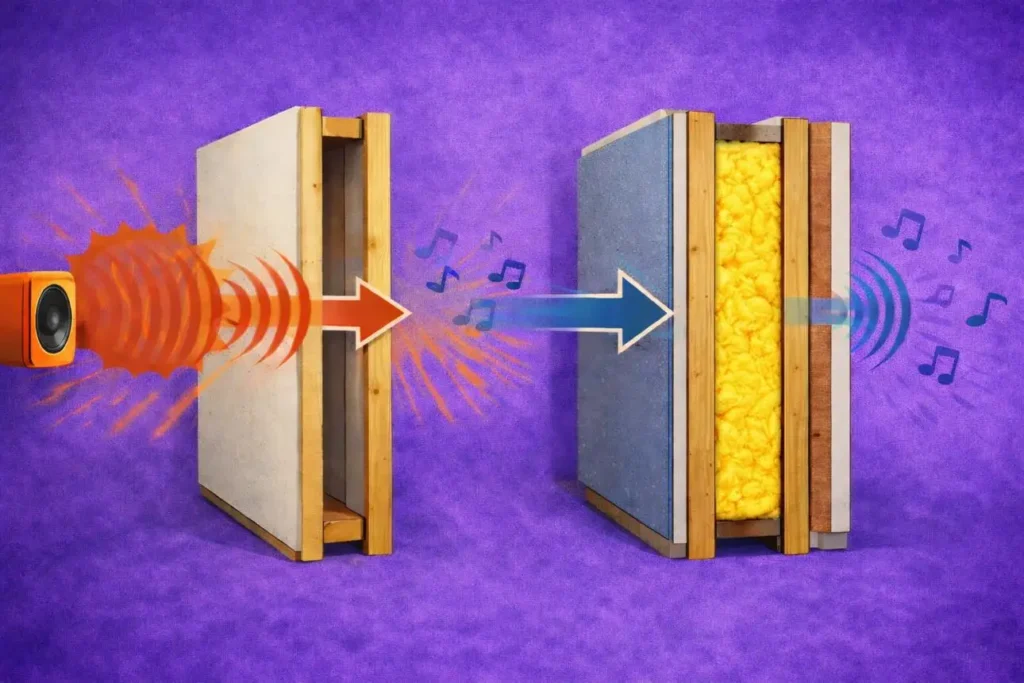
Soundproofing and sound absorption solve different problems. Understanding this difference helps you avoid buying materials that do not match your goal.
What Does Soundproofing Actually Do?
Soundproofing, also called sound isolation, reduces sound traveling from one space to another. It helps keep outside noise from entering a room and prevents noise inside the room from disturbing other people.
Effective sound isolation usually depends on mass, airtight construction, damping, and decoupling. Doors, windows, walls, floors, and ceilings all matter.
What Is Sound Absorption?
Sound absorption reduces sound reflections inside a room. Hard surfaces such as tile, glass, and bare drywall reflect sound. These reflections can make a room feel loud, hollow, or echoey.
Porous materials such as fiberglass, mineral fiber, and acoustic foam absorb some of this reflected sound. They can make speech and recordings clearer, but they do not automatically stop sound from passing through a wall.
What Is Acoustic Treatment?
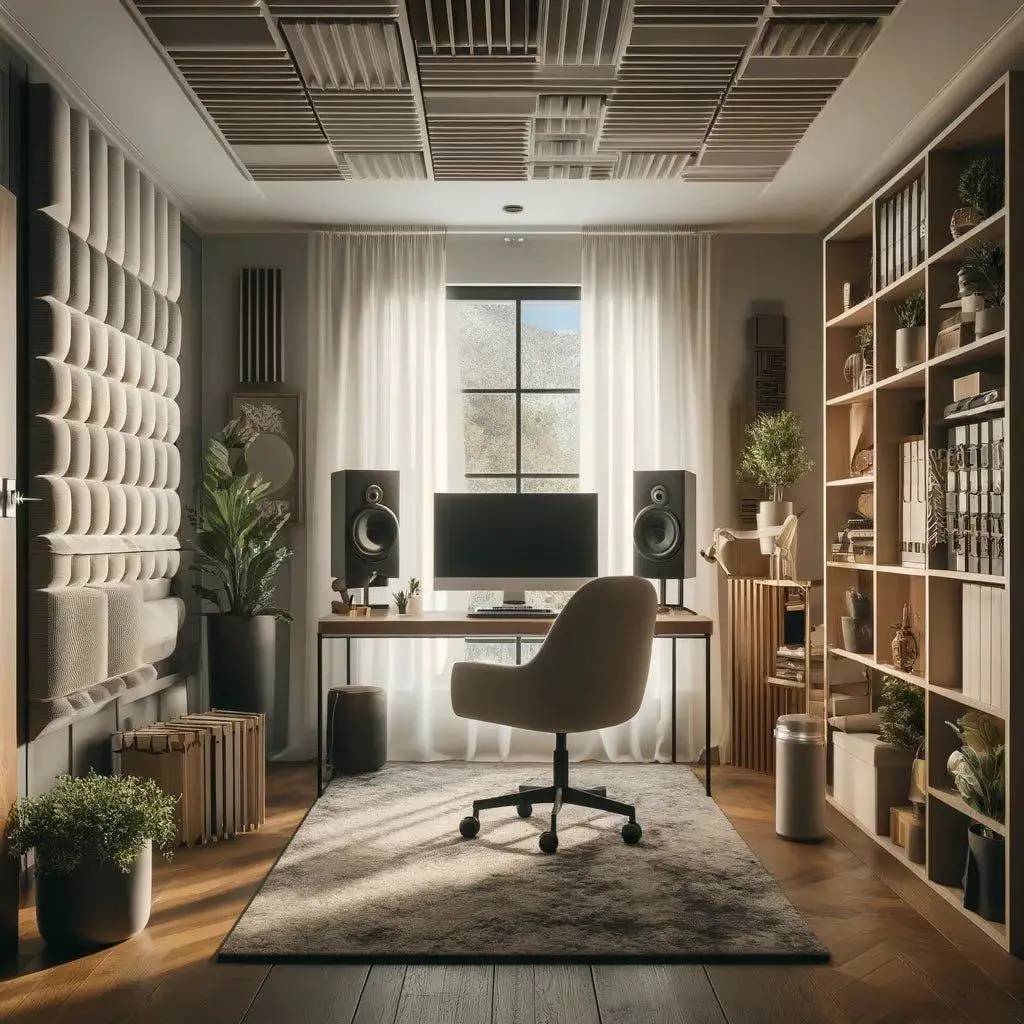
Acoustic treatment improves the sound inside a room. It is useful for home offices, recording spaces, gaming rooms, music practice rooms, and home theaters.
Common acoustic treatments include:
- Fabric-covered acoustic panels
- Acoustic foam
- Bass traps
- Ceiling clouds
- Acoustic blankets
Use these materials when you want less echo or better sound quality. Do not rely on them as the main barrier against noisy neighbors.
What Is Sound Masking?
Sound masking uses controlled background sound to make unwanted noise less noticeable. A white-noise machine, fan, or sound-masking device can help cover quiet conversations and other steady background sounds.
Sound masking does not block noise. It changes how noticeable that noise feels.
How Are STC, NRC, IIC, and CAC Ratings Different?
These ratings describe different parts of acoustic performance. Do not compare them as though they measure the same thing.
| Rating | Full name | What it measures |
|---|---|---|
| STC | Sound Transmission Class | Airborne sound isolation through a tested building assembly |
| NRC | Noise Reduction Coefficient | How much sound a material absorbs |
| IIC | Impact Insulation Class | How well a floor-ceiling assembly limits impact noise |
| CAC | Ceiling Attenuation Class | How well a ceiling system limits sound traveling through a shared ceiling space |
A higher STC generally means better airborne sound isolation. A higher IIC indicates better impact-noise isolation, while a higher NRC means a material absorbs more sound.
Always check what was tested. A rating for one wall assembly does not automatically apply to a different wall with different framing, insulation, gaps, or installation details.
First, Find Where the Noise Is Coming From
Before buying materials, identify the source and path of the noise. Otherwise, you may improve one surface while sound continues to travel through another.
Walk around the room while the noise is happening. Listen near doors, windows, shared walls, floors, ceilings, vents, and pipe openings.
| Noise problem | Areas to inspect | First place to focus |
|---|---|---|
| Traffic or street noise | Windows, exterior walls, doors | Window seals and glazing |
| Conversations from another room | Shared walls, doors, outlets | Door gaps and wall construction |
| Hallway noise | Entry door and frame | Weatherstripping and door sweep |
| Upstairs footsteps | Ceiling and floor above | Floor treatment and ceiling assembly |
| Noise from your room | Door, walls, ceiling, floor | Sealing and sound isolation |
| HVAC or plumbing noise | Ducts, vents, pipes, equipment | Vibration and duct transmission |
Is the Noise Airborne or Impact Noise?
Airborne noise travels through the air. Examples include talking, television, music, barking dogs, and traffic.
Impact noise begins when something strikes or moves against a building surface. Footsteps, dropped objects, and furniture movement can create vibrations that travel through floors, walls, and ceilings.
Some problems involve both types. A loud speaker, for example, creates airborne sound while its low-frequency vibrations may also reach the building structure.
You should identify the main problem before choosing a solution. Treating an impact-noise problem with thin acoustic foam will rarely deliver the result you expect.
How to Soundproof a Room Step by Step
Work through the following areas in order. Start with simple gaps and weak openings before considering major construction.
1. Seal Gaps Around Doors and Windows
Small openings can provide easy paths for sound. Check the edges of the door, the window frame, and visible cracks around trim.
For suitable gaps, use:
- Adhesive weatherstripping around movable door and window sections
- Flexible acoustic sealant for appropriate stationary joints
- Door sweeps to close the gap beneath doors
- Properly sized backer rod and compatible sealant for wider joints
Weatherstripping should compress when the door or window closes. It should not prevent the door from latching or create an obstruction.
For exterior window and door installation gaps, choose products made for the specific application. Low-expansion window-and-door foam may be suitable for some rough openings. Fibrous insulation alone does not create an airtight seal.
Do not seal required ventilation openings or interfere with fire-rated assemblies. Check product instructions and building requirements before making permanent changes.
2. Soundproof the Door
Doors are often weaker sound barriers than the walls around them. A hollow-core interior door may allow more noise through than a heavier solid-core door.
Try these improvements:
- Check the gap around the door.
- Install weatherstripping along the sides and top.
- Add a door sweep or suitable threshold seal at the bottom.
- Check that the latch pulls the door firmly against its seals.
- Consider a solid-core replacement if the existing door is a major weak point.
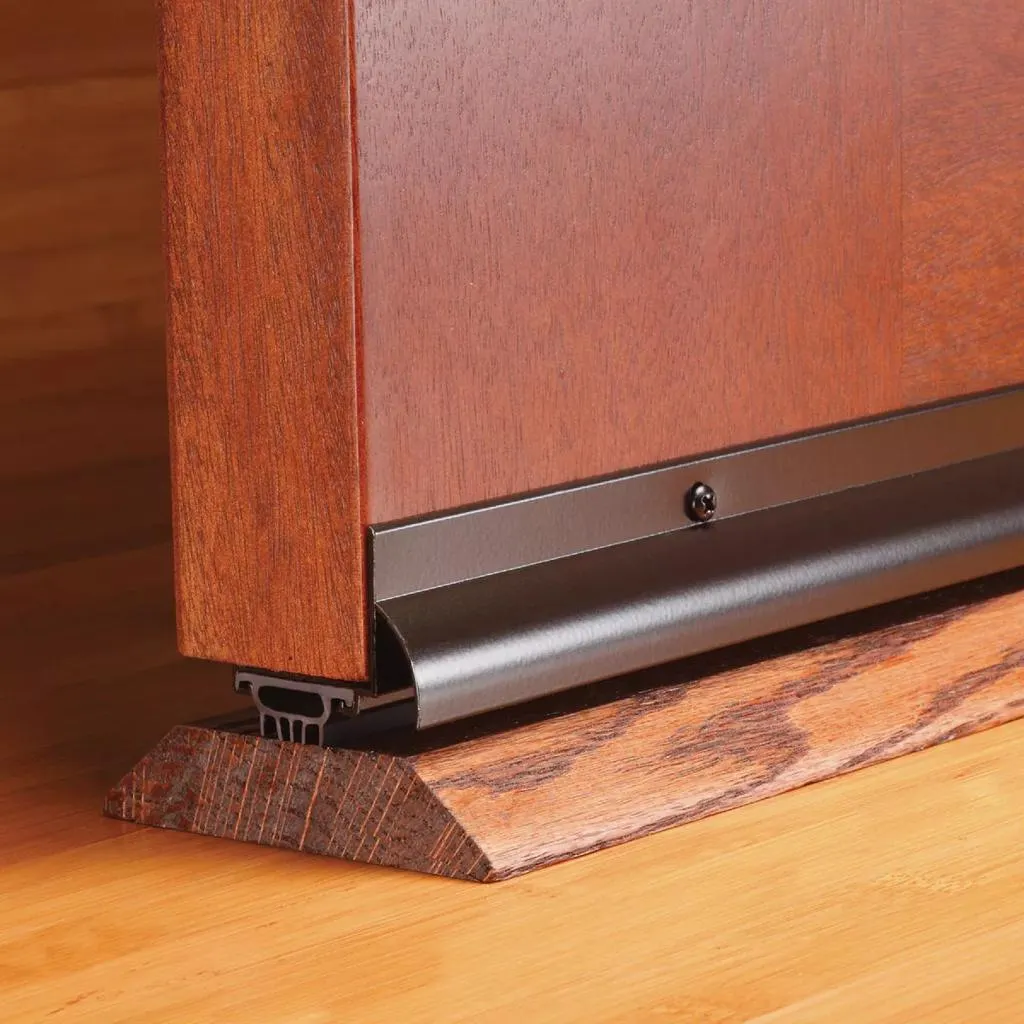
A draft stopper can be a temporary option for a renter. It is not as reliable as a properly fitted door sweep because it may move when the door opens and closes.
For stronger sound isolation, a complete door system matters. The slab, frame, perimeter seals, threshold, and installation must work together. Replacing the door without sealing the frame can leave the main problem untouched.
3. Improve Window Sound Isolation
Windows can be a major source of outside noise, especially when they have loose frames, worn seals, or gaps.
Start with basic checks:
- Make sure the window closes and locks properly.
- Inspect the weatherstripping.
- Seal suitable gaps around stationary frame joints.
- Check for loose trim and damaged caulk.
For stronger results, consider a properly fitted interior window insert or an additional storm-window layer. A second sealed glazing layer can improve sound isolation without requiring a full window replacement.
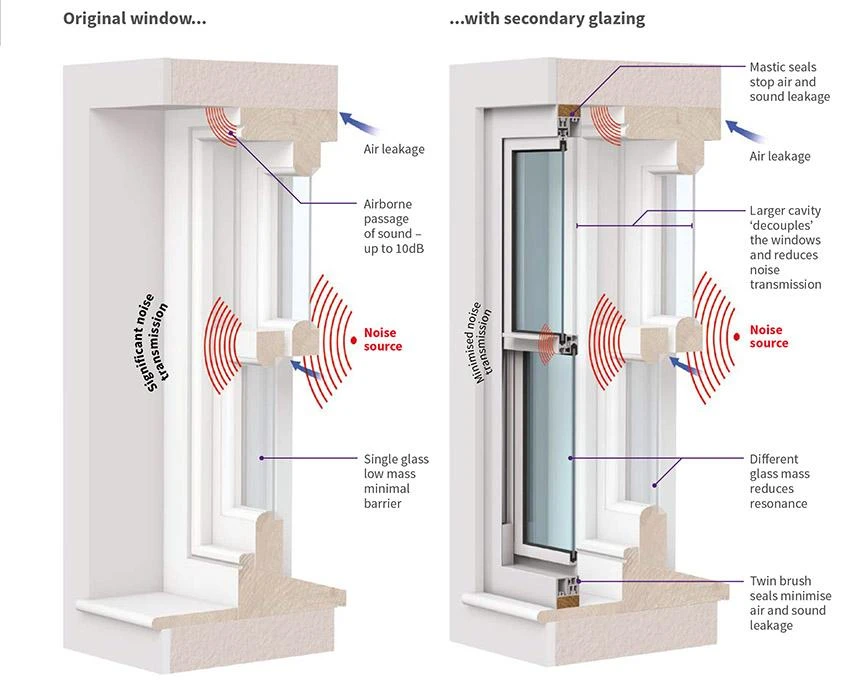
Heavy curtains may soften some noise and reduce reflections inside the room. However, ordinary curtains will not provide the same isolation as a well-sealed window system.
4. Soundproof Existing Walls
A thin shared wall may be the main path for conversations, television noise, or music.
Start by checking for obvious gaps around trim, electrical boxes, pipes, and other penetrations. Address suitable openings with materials approved for that location.
For a more permanent wall upgrade, consider:
- Adding another layer of drywall.
- Using a suitable damping compound between drywall layers.
- Adding mineral wool or fiberglass insulation inside an accessible wall cavity.
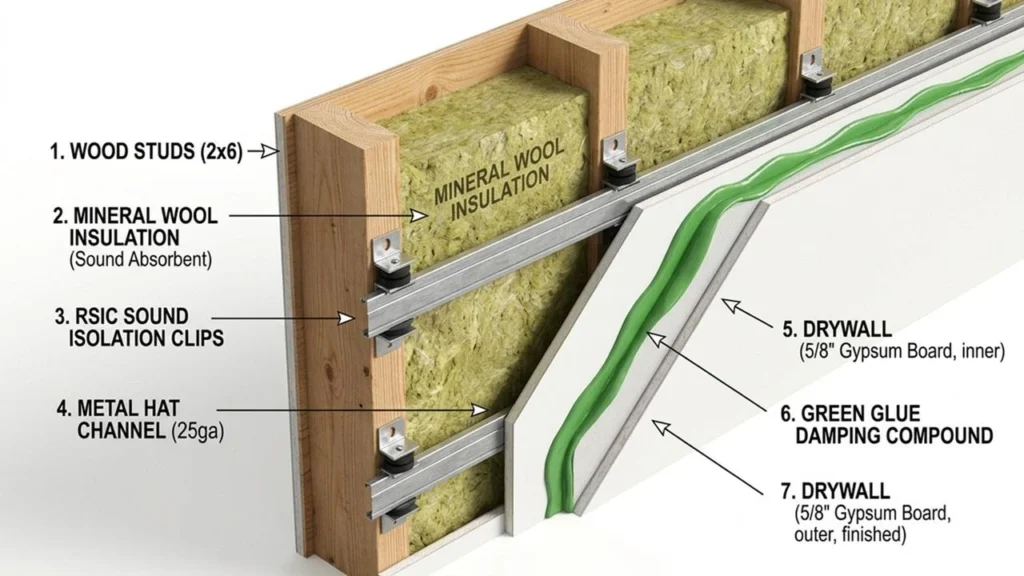
- Installing resilient channels or sound isolation clips as part of a designed assembly.
- Using mass-loaded vinyl as one layer in a compatible wall system.
Adding drywall increases the wall’s mass. Damping can reduce vibration within the assembly. Resilient channels and isolation clips help reduce direct mechanical connections between the drywall and framing.
Mineral wool and fiberglass are useful inside wall cavities, but insulation alone does not make a wall soundproof. The complete assembly, including the framing, drywall, seals, and connections, determines the result.
For major changes, consult a qualified drywall or acoustic professional. An incorrectly installed isolated wall can lose much of its intended performance.
5. Reduce Noise Through Floors
Floors need different treatment depending on the type of noise.
If the problem is echo inside your own room, a rug and dense rug pad can soften reflections. If you want to reduce footsteps or impact noise traveling between floors, the floor construction needs more attention.
Options include:
- Thick carpet and suitable padding
- Dense rubber or cork underlayment
- Acoustic floor underlayment beneath new flooring
- Properly designed floating-floor assemblies for more demanding projects
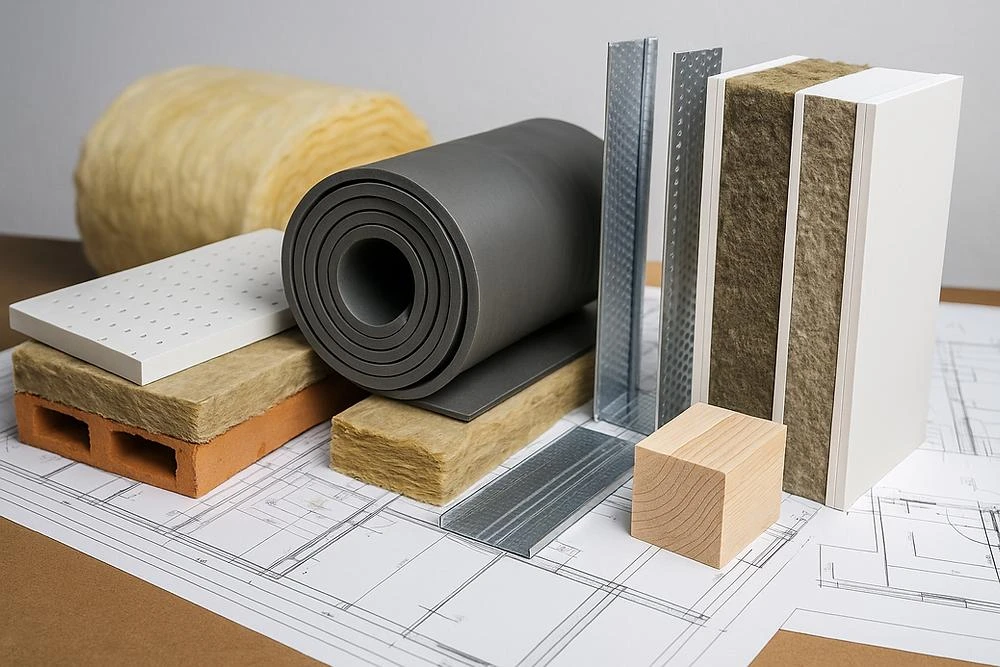
A rug may improve comfort and reduce some surface noise. It will not solve every impact-noise problem in a multi-story building.
When renovating, check the flooring manufacturer’s instructions and the underlayment’s impact-isolation test data. The complete floor-ceiling assembly matters.
6. Soundproof the Ceiling
Noise from an upstairs neighbor can be difficult to control from the room below. Footsteps and furniture movement often travel through the floor structure.
The strongest approach is usually to treat the floor above. Suitable underlayment, carpet padding, and other floor treatments can reduce impact transmission at its source.
When access to the upper floor is not possible, a contractor may recommend a ceiling system using isolation clips, resilient channels, insulation, and additional drywall. The system must account for the existing framing and any paths around the ceiling.
Acoustic ceiling tiles can reduce reverberation within a room. They do not automatically block noise from an occupied room above, especially when a shared ceiling cavity remains open.
7. Check Vents, Pipes, Electrical Boxes, and Other Openings
Sound can travel through openings that are easy to overlook. Inspect the areas around plumbing, electrical boxes, service penetrations, and ventilation systems.
For appropriate gaps, use compatible acoustic sealant or approved putty products. Electrical boxes may require specifically rated putty pads or fire-rated products. Have electrical work handled by a qualified person, and never cover wiring or equipment with materials not approved for that use.
Vents and ducts need special care. Do not block supply vents, return-air grilles, exhaust vents, or combustion-air openings to make a room quieter.
When noise travels through an HVAC system, ask an HVAC professional about suitable duct silencers, vibration isolation, or other noise-control options that preserve required airflow.
8. Consider Advanced Wall and Room Construction
Some noise problems need more than surface treatments. Recording rooms, drum rooms, and spaces that need strong separation may require a purpose-built isolation system.
Advanced methods can include:
- Multiple layers of drywall
- Damping compound between rigid layers
- Resilient channels or isolation clips
- Isolated floor and ceiling assemblies
- Separate framing with minimal structural connections
- A room-within-a-room design
These systems aim to reduce both airborne transmission and structure-borne vibration. They also require careful treatment of doors, windows, ventilation, wiring, and other openings.
A room-within-a-room can be effective for demanding projects, but it uses space and costs much more than basic DIY improvements. It is usually a job for an acoustic designer or experienced contractor.
How to Soundproof a Room Without Construction
Renters and homeowners who do not want to open walls still have useful options. These changes usually offer limited or moderate improvement rather than complete sound isolation.
Use Removable Door Seals
Try removable weatherstripping, a fitted draft stopper, or a door sweep that does not damage the door or floor. Check your lease and the door’s fire and egress requirements before making permanent changes.
Add a Removable Window Insert
A removable interior window insert can add another sealed layer to an existing window. It may be a better option for outside noise than curtains alone.
Measure carefully and choose an insert designed for the window type. A loose panel with open edges will not provide the same result as a properly fitted system.
Use Rugs and Dense Furniture
A thick rug and dense pad can reduce reflections from a hard floor. A filled bookshelf or wardrobe may also change the room’s acoustics, but furniture is not a tested soundproof barrier.
Keep furniture stable and avoid covering heaters, electrical equipment, or required access areas.
Hang Heavy Curtains or Acoustic Blankets
Thick curtains and moving blankets can soften reflections and make a room feel less lively. Some purpose-built acoustic blankets combine absorption with a barrier layer, but performance depends on the product and installation.
Do not assume that a regular moving blanket will stop conversations or bass from passing through a wall.
Reduce Noise at the Source
Sometimes the simplest fix is to make less noise in the first place. Use headphones for gaming, choose quieter keyboard switches, place noisy equipment on suitable vibration pads, and avoid positioning speakers directly against a shared wall.
For a home office, a close microphone can help you speak at a lower volume. This can be more practical than trying to rebuild a wall.
How to Soundproof a Room Cheaply
If you have a limited budget, work from the simplest improvements to the more expensive ones. Do not spend everything on acoustic foam before checking the door and window gaps.
Free Ways to Reduce Noise
Start with changes that cost little or nothing:
- Move speakers away from shared walls.
- Lower the volume of televisions and speakers.
- Use headphones for late-night gaming or music.
- Move your desk away from a noisy wall.
- Close windows and doors properly.
- Rearrange furniture to improve comfort and room acoustics.
These steps do not create a soundproof room, but they may reduce the noise problem without construction.
Affordable Soundproofing Improvements
Consider buying weatherstripping, a suitable door sweep, a removable draft stopper, a dense rug pad, or a properly fitted window seal.
Prioritize the opening or surface that causes the most noise. A door sweep is a better purchase than wall foam when sound is escaping through a large gap beneath the door.
Which Cheap Soundproofing Methods Actually Help?
| Method | What it can help with | Main limitation |
|---|---|---|
| Door sweep | Noise leaking beneath a door | Does not improve a weak wall |
| Weatherstripping | Gaps around doors and windows | Works only when fitted correctly |
| Thick rug and pad | Room reflections and some floor noise | Limited effect on sound through the structure |
| Dense furniture | Room acoustics and minor noise changes | Not a tested isolation system |
| Heavy curtains | Reflections and some window noise | Cannot replace sealed glazing |
| Moving blankets | Reflections and temporary dampening | Not a reliable wall barrier |
| Acoustic foam | Echo and reverberation | Does not block sound through walls |
Cheap Materials to Avoid
Do not waste money on egg cartons, thin craft foam, or products that claim to make any room completely soundproof with a few adhesive panels.
These materials may change reflections, but they do not provide the mass, airtight sealing, and isolation needed for serious sound blocking. Be careful with products marketed as “soundproof” when they provide no tested performance data for the assembly you plan to use.
Best Materials for Soundproofing a Room
Different materials perform different jobs. Use the following table to compare their main purpose before choosing a product.
| Material | Main purpose | Best use |
|---|---|---|
| Acoustic foam | Sound absorption | Reducing echo and reflections |
| Fabric-covered acoustic panels | Sound absorption | Offices, studios, and media rooms |
| Bass traps | Low-frequency room treatment | Music and recording spaces |
| Mineral wool | Absorption inside cavities | Wall and ceiling assemblies |
| Fiberglass insulation | Absorption inside cavities | Walls and floors |
| Mass-loaded vinyl (MLV) | Adds flexible mass | Suitable wall and floor assemblies |
| Soundproof drywall | Adds mass | Wall and ceiling upgrades |
| Green Glue damping compound | Damps vibration between layers | Multi-layer drywall assemblies |
| Resilient channels and isolation clips | Decoupling | Wall and ceiling construction |
| Acoustic sealant | Seals suitable joints | Wall edges and penetrations |
| Weatherstripping | Seals movable gaps | Doors and windows |
| Door sweeps | Seals the bottom of a door | Hallway and room noise |
| Window inserts | Adds a sealed glazing layer | Outside and traffic noise |
| Acoustic floor underlayment | Reduces some impact transmission | Floors during renovation |
Acoustic Foam
Acoustic foam is useful when a room has too much echo. It absorbs some reflected sound and can improve speech clarity.
It is not a replacement for drywall, mass-loaded vinyl, or an isolated wall system. Use it for room treatment, not as the only method of soundproofing.
Acoustic Panels
Fabric-covered acoustic panels often contain mineral wool, fiberglass, or other sound-absorbing material. They are useful in recording rooms, home offices, and media spaces.
Check the manufacturer’s absorption data and installation requirements. Do not assume every decorative panel blocks sound from reaching the next room.
Mass-Loaded Vinyl
Mass-loaded vinyl is a flexible, dense sheet used as an added barrier in some wall, floor, and ceiling assemblies. It can contribute to sound isolation when correctly installed with other suitable materials.
Its performance depends on the full assembly and the way edges, joints, and penetrations are sealed.
Soundproof Drywall
Sound-rated drywall products are designed to improve sound isolation compared with some standard drywall assemblies. Another option is to add a second layer of suitable drywall with a damping compound between layers.
The supporting frame and installation still matter. A product label alone cannot guarantee the result in your room.
Fiberglass and Mineral Wool
Fiberglass and mineral wool insulation can absorb sound within wall, floor, and ceiling cavities. They are often part of a sound-isolating assembly.
They do not replace airtight sealing or the mass of the wall layers. Choose the right product for the cavity and follow the manufacturer’s installation instructions.
Resilient Channels, Isolation Clips, and Green Glue
Resilient channels and sound isolation clips help reduce direct vibration transfer between framing and drywall. Green Glue is a damping compound used between rigid layers to reduce vibration within an assembly.
These products are most useful when installed as part of a suitable design. A contractor should check framing, spacing, fasteners, and the full wall or ceiling specification.
Soundproof Blankets and Curtains
Purpose-built acoustic blankets may combine a barrier layer with an absorptive surface. They can be useful for temporary or targeted applications.
Ordinary curtains and moving blankets mostly soften sound reflections. Their effect on sound transmission is limited unless they are part of a specifically designed barrier system.
How to Soundproof a Room From Outside Noise
Outside noise can come from traffic, nearby businesses, construction, barking dogs, or conversations. The first step is to identify the surface where the sound is entering.
Reduce Traffic Noise
Check window locks, seals, and frame gaps. For persistent traffic noise, consider a properly fitted interior window insert or a more suitable glazing upgrade.
Heavy curtains may soften some high-frequency noise, but they will not provide the same result as a sealed window assembly.
Reduce Noise From Neighbors
If voices or television noise come through a shared wall, inspect the wall and adjoining door. Seal appropriate gaps, and consider a professional assessment before adding drywall or isolation clips.
If the sound comes through the building structure, adding panels to your side of the wall may not be enough. Ask the building manager or an acoustic professional to investigate the path.
Reduce Hallway Noise
Hallway noise often reaches a room through the entry door. Fit weatherstripping around the frame and a suitable door sweep at the bottom.
A solid-core door may help when the existing door is lightweight. Make sure the replacement is compatible with the building’s fire and safety requirements.
How to Keep Sound Inside a Room
Some people want to stop noise from leaving a room rather than stop outside noise from entering. The same principles apply, but the source of the sound may be a voice, keyboard, television, instrument, or speaker.
Soundproof a Gaming Room or Home Office
For gaming and voice chat, start with the sound source:
- Use a headset rather than room speakers.
- Choose a quieter keyboard and mouse.
- Use a desk mat to reduce key and equipment noise.
- Position your microphone close enough to avoid shouting.
- Move the desk and speakers away from shared walls.
- Seal door gaps if noise travels into the hallway.
Acoustic panels can reduce echo during voice calls. They will not, by themselves, stop your voice from reaching another room.
Soundproof a Music Practice Room
Music rooms require more careful planning because instruments produce different frequencies and sound levels. A violin, guitar, piano, and drum kit do not create the same acoustic problem.
First, identify whether the main concern is sound leaving the room or echo inside it. Use suitable absorption for room acoustics, then consider door seals, wall mass, damping, and decoupling for sound isolation.
Soundproof a Room for Drums
Drums can create strong low-frequency sound and structural vibration. This makes them harder to isolate than quiet speech or keyboard clicks.
A drum room may need an isolated floor, decoupled wall and ceiling systems, and carefully designed doors and ventilation. A room-within-a-room approach may be appropriate for demanding projects, but it requires professional planning.
Soundproof a Recording or Podcast Room
A recording room often needs both sound isolation and acoustic treatment. Use isolation methods to reduce noise entering and leaving the room. Then use acoustic panels and bass traps to control reflections and low-frequency buildup.
This creates a quieter recording environment without confusing sound quality inside the room with sound blocking between rooms.
How to Reduce Footstep Noise From Upstairs
Footstep noise is usually impact noise. It travels through the floor structure and can appear as thumps, creaks, or vibrations in the room below.
The most effective treatment is often on the floor above. Carpet, suitable padding, and impact-rated underlayment may help reduce the noise.
When the upper floor cannot be changed, a contractor can assess a ceiling assembly with isolation clips, channels, insulation, and additional drywall. Treating only the ceiling surface with foam will not solve the main structural path.
In an apartment, speak with the property manager before making changes. Building rules may restrict flooring, ceiling work, or alterations to shared structures.
How Much Does It Cost to Soundproof a Room?
The cost depends on the room size, the surfaces being treated, the noise problem, and whether you choose DIY improvements or professional construction.
A 2026 Angi cost guide estimates professional soundproofing at an average of about $1,881, with a reported range of $1,036 to $2,743. It also estimates roughly $10 to $30 per square foot of treated surface, including materials and labor. These are national estimates, not a quote for your specific room.
| Project type | What affects the cost |
|---|---|
| Basic DIY improvements | Weatherstripping, door sweeps, rugs, and removable seals |
| Door upgrade | Door slab, frame, perimeter seals, and threshold |
| Window upgrade | Inserts, secondary glazing, or replacement windows |
| Wall upgrade | Drywall layers, damping compound, insulation, and labor |
| Ceiling upgrade | Isolation clips, channels, drywall, and access |
| Studio isolation | Room size, decoupling, ventilation, and specialist design |
Remember that the square-foot estimate applies to the treated surface, not simply the floor area of the room. A 12-by-12-foot room has 144 square feet of floor area, but treating its walls and ceiling involves much more surface area.
For a more accurate estimate, ask contractors to specify which surfaces they will treat and what performance the proposed assembly is designed to achieve. Compare the materials, installation details, and expected limitations rather than comparing prices alone.
Can You 100% Soundproof a Room?
A completely silent room is not a realistic target for most homes. Even well-designed isolation rooms can have remaining noise from doors, ventilation, structural connections, and other paths.
You can still make a room much quieter. The result depends on the starting construction, sound source, frequency range, room layout, and budget.
Set a practical goal. You might want to make conversations less understandable in the next room, reduce traffic noise in a bedroom, or lower the sound escaping from a music room. Each goal requires a different level of work.
Common Soundproofing Mistakes to Avoid
Avoid these mistakes when planning your project:
- Using acoustic foam to block outside noise: Foam helps reduce echo, not sound transmission through a wall.
- Ignoring gaps: A small opening around a door or window can undermine other improvements.
- Treating only one surface: Sound may travel through the floor, ceiling, or adjoining structure.
- Ignoring flanking paths: Noise can travel around a wall through connected framing, ceilings, ducts, and other openings.
- Buying by product name alone: Look for the product’s tested performance and the assembly it is designed for.
- Blocking ventilation: Never cover required supply, return, exhaust, or combustion-air openings.
- Making unsafe electrical changes: Use qualified help and products approved for electrical and fire-rated applications.
- Expecting complete silence on a small budget: Basic fixes can help, but serious isolation usually requires more extensive work.
Frequently Asked Questions
How Can I Soundproof a Room Cheaply?
Start by sealing door and window gaps. Add a suitable door sweep, use a thick rug and pad to soften room reflections, and reduce noise at its source with headphones or quieter equipment.
Choose improvements based on the actual noise path. Acoustic foam is not a substitute for a sound-isolating wall.
What Cancels Out Noise in a Room?
No single material cancels every type of noise. Sound isolation uses mass, airtight sealing, damping, and decoupling, while sound absorption reduces reflections and echo.
Sound masking can make some unwanted noise less noticeable, but it does not block sound from entering or leaving.
How Can I Soundproof an Existing Room?
Start with doors, windows, gaps, and penetrations. You can add weatherstripping, door sweeps, window inserts, or additional drywall without necessarily rebuilding the entire room.
For serious noise through walls or ceilings, ask a professional to assess the existing construction and possible flanking paths.
How Do I Make It So No One Can Hear Me in My Room?
First, reduce the sound at its source. Use headphones, lower your speaking volume, and place speakers away from shared walls.
Then seal door gaps and investigate the shared wall or ceiling. Stronger privacy may require a heavier door or a professionally designed wall assembly.
How Much Does Soundproofing a Room Cost?
A 2026 Angi guide reports an average professional project cost of about $1,881, with many projects falling between $1,036 and $2,743. Your actual price depends on room size, treated surfaces, materials, access, and labor.
Does Acoustic Foam Actually Soundproof a Room?
No. Acoustic foam mainly absorbs reflections and reduces echo inside a room. It does not provide the mass and isolation needed to block most sound passing through walls, floors, or ceilings.
How Do You Soundproof a Room in an Apartment?
Begin with renter-friendly improvements such as removable door seals, a draft stopper, thick rugs, and suitable window inserts. Ask your landlord or property manager before changing doors, walls, ceilings, or shared building components.
What Is the Best Material for Soundproofing Walls?
There is no single best material for every wall. A sound-isolating assembly may combine drywall, damping compound, insulation, resilient channels or clips, and properly sealed edges.
Choose a complete tested system that matches the type of noise and the existing wall construction.
How Do You Soundproof a Room for Drums?
Drum rooms usually need stronger isolation than ordinary bedrooms or home offices. A designed system may use decoupled walls, an isolated floor, a suitable ceiling assembly, and controlled ventilation.
Because low-frequency sound and vibration can travel through the building structure, consult an acoustic professional before starting construction.
References and Further Reading
- USG: Acoustics 101 — Sound absorption, sound transmission, STC, NRC, IIC, and CAC.
- This Old House: A Guide to Soundproofing a Room from Floor to Ceiling — Practical door, window, wall, floor, and ceiling improvements.
- Lowe’s: How to Soundproof a Room — Beginner-friendly room treatments and DIY options.
- U.S. Department of Energy: Air Sealing Around Doors and Windows — Air sealing at window and door rough openings.
- CDC/NIOSH: Implement Engineering Controls — Noise barriers, sound absorption, vibration, and low-frequency noise.
- Angi: How Much Does It Cost to Soundproof a Room? — Updated 2026 cost estimates.