What Is LVP Flooring? A Complete Guide for Homeowners
Luxury vinyl plank (LVP) flooring is a synthetic flooring product made in long, plank-shaped pieces. It is designed to imitate natural materials such as hardwood and stone. Its layered construction combines a decorative surface with protective and structural materials.
Homeowners choose LVP for its realistic designs, easy maintenance, and resistance to everyday spills. However, products differ in their core construction, wear layers, installation systems, and warranties. Those differences affect how a floor performs and where you can install it.
This guide explains what LVP flooring is made of, how SPC and WPC cores differ, and whether LVP is waterproof. It also covers the advantages, disadvantages, installation requirements, costs, and specifications worth checking before you buy.
What Is LVP Flooring?
LVP stands for luxury vinyl plank. It is a type of resilient vinyl flooring manufactured in individual planks. These planks usually feature a printed design that imitates wood, stone, or other natural surfaces.
LVP does not use natural hardwood as its main structural material. Instead, manufacturers combine vinyl-based materials with decorative and protective layers. Some products also include a rigid composite core or an attached underlayment pad.
LVP belongs to the broader vinyl flooring category. Its plank format gives it a wood-floor appearance, while its synthetic construction provides different maintenance and moisture characteristics from natural wood.
What Does LVP Stand for in Flooring?
LVP means luxury vinyl plank. The word “plank” describes its long, narrow format. “Luxury vinyl” identifies the type of vinyl flooring.
You may also see terms such as luxury vinyl tile (LVT), rigid-core vinyl, and resilient flooring. These terms describe related products, but they do not all mean the same thing.
LVP is not short for laminated vinyl plank. It is also not laminate flooring. The two products use different core materials and construction methods.
What Does Luxury Vinyl Plank Flooring Look Like?
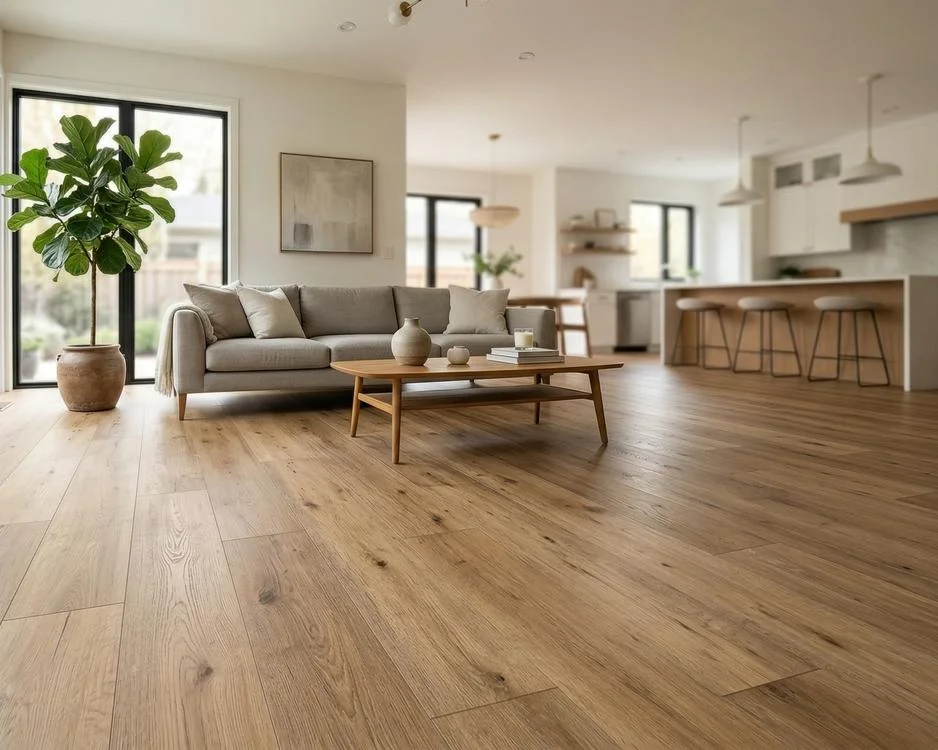
LVP is designed to reproduce the appearance of natural flooring materials. Common styles include:
- Wood looks: Oak, maple, hickory, walnut, and other wood-inspired patterns.
- Stone looks: Designs that resemble slate, marble, and natural stone.
- Neutral finishes: Light, gray, and warm wood tones for different interior styles.
- Textured finishes: Embossed surfaces that add texture to the printed design.
The quality of the printed pattern, texture, and surface finish affects how realistic a floor looks.
Check several planks together before buying. Look at grain details, surface texture, edge design, and how often the same pattern repeats. A sample that looks convincing on its own may appear repetitive across a large room.
How Is LVP Different From Regular Vinyl Flooring?
LVP is one format of vinyl flooring. Other formats include luxury vinyl tile and sheet vinyl.
| Flooring type | Format | Common appearance |
|---|---|---|
| LVP | Individual planks | Wood and plank-style designs |
| LVT | Individual tiles | Stone, ceramic, and tile-style designs |
| Sheet vinyl | Large rolls | Continuous patterns across a room |
LVP and LVT can use similar materials and construction methods. Their main visible difference is their shape and intended design.
Sheet vinyl comes in large rolls rather than individual planks or tiles. Installation methods and product specifications vary across all three formats.
What Is LVP Flooring Made Of?
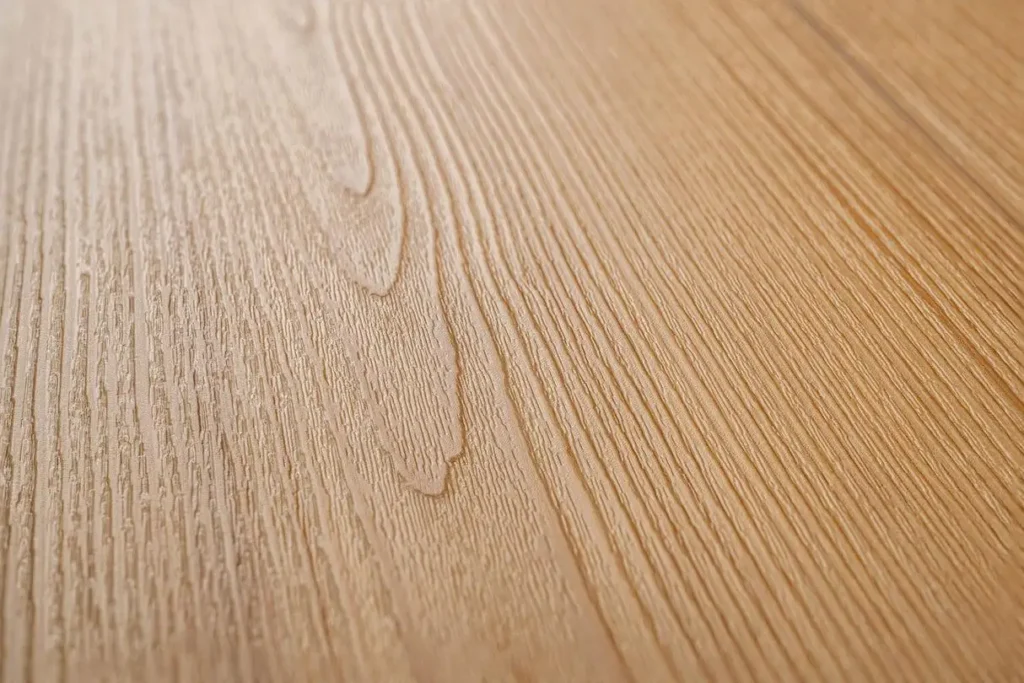
LVP flooring uses several materials and layers to create its appearance and structure. A common rigid-core design includes a protective wear surface, a decorative layer, a core, and sometimes an attached backing pad.
However, not every product has exactly four separate layers. Some manufacturers describe three main structural layers, while others identify the backing or attached pad as an additional layer.
ASTM F3261-26 covers resilient flooring in modular plank or tile formats with a rigid polymeric core and a protective wear surface. It also recognizes products with or without an attached underlay. This standard applies to rigid-core products, not every type of vinyl plank flooring.
1. Wear Layer
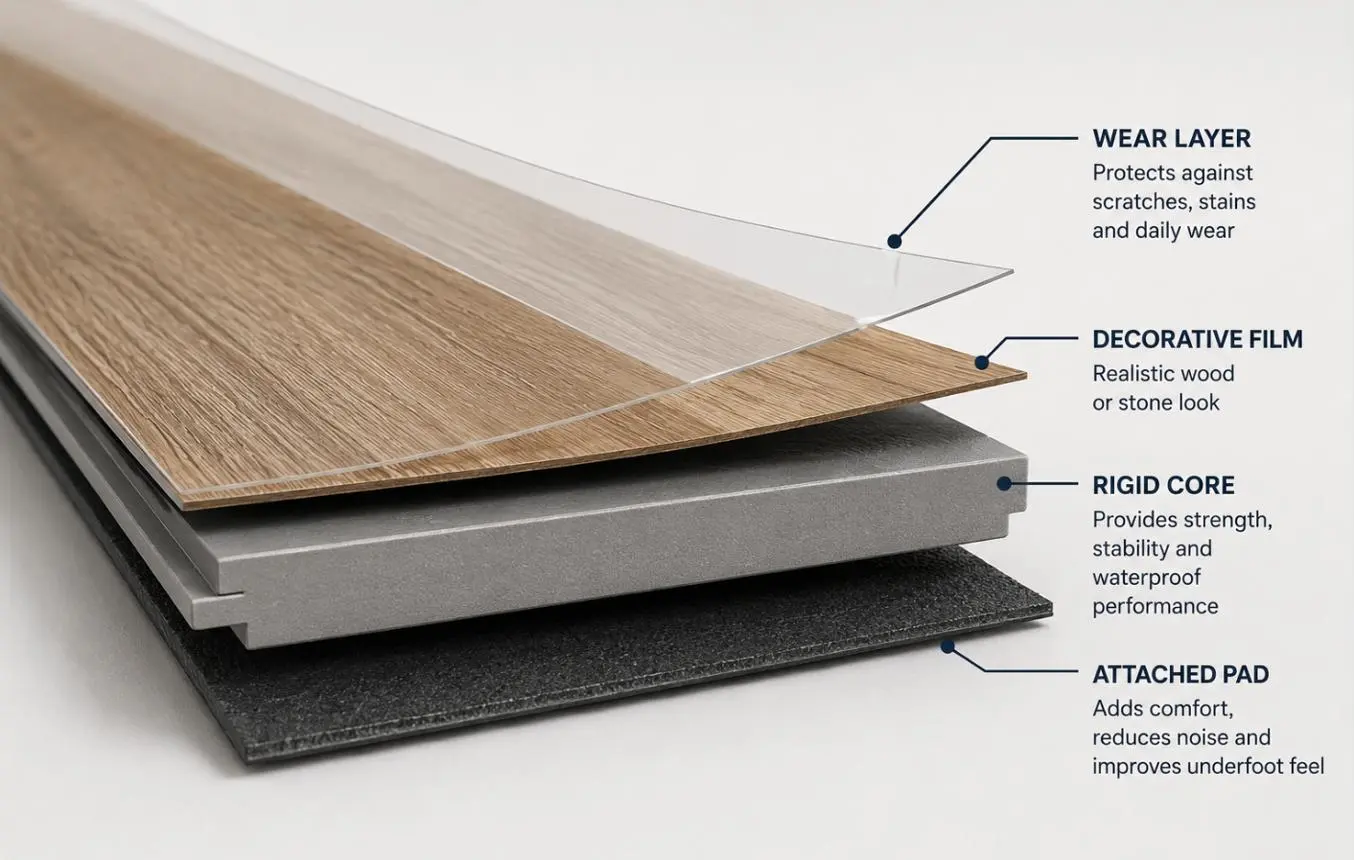
The wear layer is the protective surface above the decorative design. It helps protect the floor from everyday scuffs, stains, and surface wear.
Manufacturers commonly measure its thickness in mils. One mil equals one-thousandth of an inch. It does not mean one millimeter.
| Wear layer | Equivalent thickness |
|---|---|
| 12 mil | 0.012 inches |
| 20 mil | 0.020 inches |
| 30 mil | 0.030 inches |
A thicker wear layer provides more material for surface protection. However, thickness alone does not determine the complete floor’s durability. The surface coating, product construction, traffic, and maintenance also matter.
Some manufacturers use polyurethane-based coatings or other surface treatments. Check the technical specification to identify the actual finish rather than assuming every product uses the same coating.
Do not confuse wear-layer thickness with the total thickness of the plank. They describe different measurements.
2. Decorative Layer
The decorative layer gives LVP its visible appearance. It usually contains a printed film that imitates wood grain, stone, or another design.
Manufacturers use different printing methods, colors, and patterns. Some products also feature embossed textures that follow the printed grain.
This layer explains why two planks with similar construction can have very different appearances. Better pattern variation and realistic texture can make a floor look more natural.
When choosing a product, inspect several planks from different cartons. This helps you identify repeated patterns and noticeable color differences.
3. Core Layer
The core is the central structural part of the plank. It influences rigidity, stability, and how the flooring feels underfoot.
Some products use flexible vinyl construction. Others use a rigid polymeric core, including SPC or WPC designs.
SPC and WPC are common industry terms, but their exact formulations can vary between manufacturers. Always check the product’s technical documentation for its actual core composition.
4. Backing Layer and Attached Underlayment
The backing forms the bottom part of the plank. Some products include an attached pad that may improve sound performance and underfoot comfort.
Other products require a separate underlayment, while some do not allow one at all.
An attached pad does not automatically make a floor soundproof. Its performance depends on the entire flooring system, including the subfloor and installation.
Never add a separate underlayment without checking the product instructions. An incompatible or overly soft layer can affect the locking system and floor performance.
What Are the Different Types of LVP Flooring?
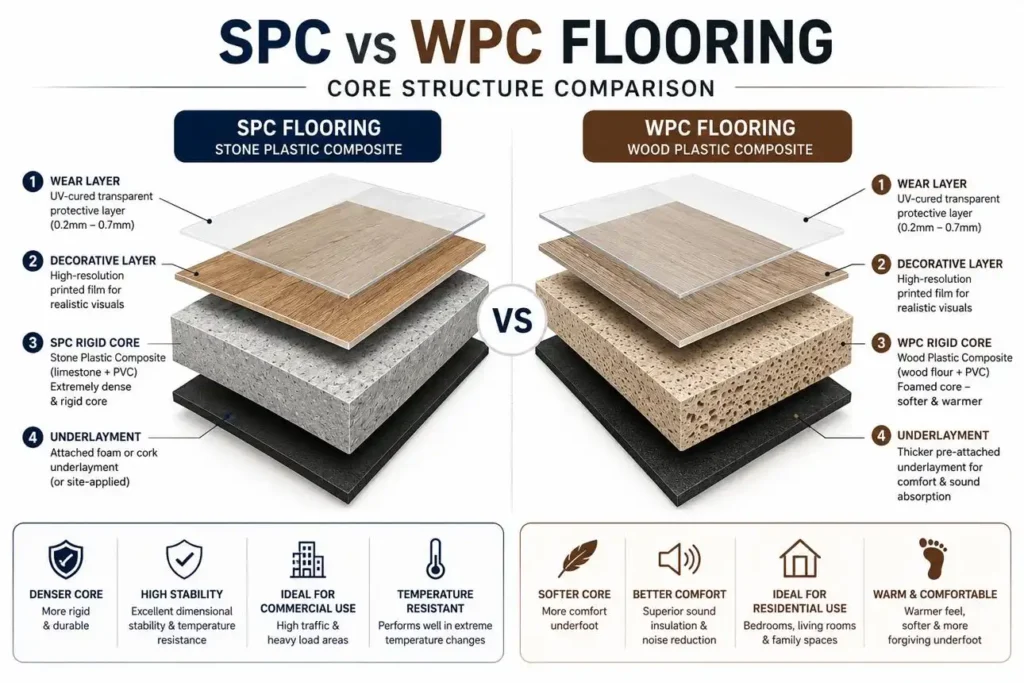
LVP products differ in their core construction and installation systems. Two common rigid-core designs are SPC and WPC.
SPC Vinyl Plank Flooring
SPC commonly stands for stone plastic composite or stone polymer composite. It describes a rigid-core flooring construction that commonly uses vinyl-based material and mineral filler.
SPC products generally have a firm, dense core. Manufacturers use this construction in products designed for residential and commercial applications.
Common characteristics include:
- A rigid central core.
- A firm feel underfoot.
- Options with click-lock floating installation.
- Different wear-layer and total-thickness specifications.
- Product designs for different traffic levels.
SPC does not automatically mean scratch-proof or waterproof under every condition. Check the full product specification and warranty.
WPC Vinyl Plank Flooring
WPC commonly stands for wood plastic composite or wood polymer composite. It describes a different composite-core construction from SPC.
WPC products are often marketed for their cushioned feel underfoot. Some use foamed composite construction, but formulations differ between manufacturers.
Do not assume every WPC product contains the same amount or type of wood material. Check the technical specification before comparing products.
SPC vs. WPC: What Is the Difference?
| Feature | SPC | WPC |
|---|---|---|
| Core design | Rigid mineral-filled composite | Different composite formulation, often foamed |
| General feel | Firm and dense | Often more cushioned |
| Construction | Rigid core | Rigid composite core |
| Product variation | Depends on manufacturer | Depends on manufacturer |
| Main consideration | Core structure and installation compatibility | Core structure and underfoot feel |
Neither core type is automatically better for every home. Compare the complete product, including its wear layer, attached backing, warranty, and installation requirements.
Flexible and Rigid Core Vinyl Flooring
Flexible-core vinyl and rigid-core vinyl describe different construction approaches.
Flexible products have a less rigid structure. Rigid-core products use a firmer central layer, which may include SPC or WPC construction.
A rigid core does not remove the need for subfloor preparation. Uneven surfaces can still affect joints and installation quality.
Choose the construction that suits the room, subfloor, traffic, and manufacturer’s recommendations.
Click-Lock vs. Glue-Down LVP Flooring
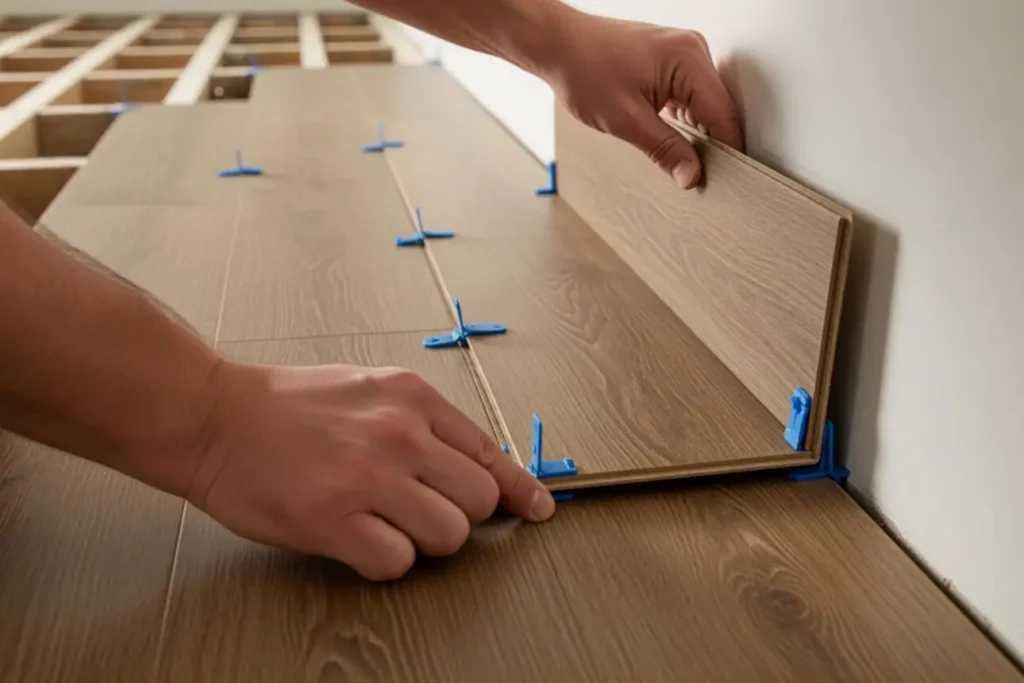
LVP also comes in different installation systems.
Click-lock LVP uses specially shaped plank edges that connect to adjoining planks. Many click-lock products form a floating floor, which means the flooring is not directly bonded to the subfloor.
Glue-down LVP uses an approved adhesive to attach the planks to the prepared subfloor.
| Feature | Click-lock | Glue-down |
|---|---|---|
| Attachment | Planks connect to each other | Adhesive bonds planks to the subfloor |
| Floor system | Usually floating | Directly bonded |
| Preparation | Requires a suitable, flat surface | Requires suitable surface and adhesive |
| Repair | Replacement depends on access and layout | Damaged sections usually need removal |
| Requirements | Follow locking-system instructions | Follow adhesive and installation instructions |
The correct method depends on the product and installation conditions. Some products support only one method. Others allow both under specific conditions.
What Are the Benefits of LVP Flooring?
LVP offers several features that make it popular for residential renovations. Its actual performance depends on the product, installation, and conditions in the room.
Water Resistance and Moisture Protection
Many LVP products resist water at the plank surface. Some manufacturers also offer waterproof product warranties.
This makes suitable products practical for rooms where everyday spills and splashes occur. However, water resistance does not mean the entire installed floor can withstand every moisture problem.
Water may reach seams, edges, adhesives, or the subfloor. Water entering from below can also cause problems even when the plank itself does not absorb it.
Durability and Scratch Resistance
The wear layer helps protect the decorative surface from everyday use. This makes many LVP products suitable for busy households.
However, LVP is not completely scratch-proof or dent-proof. Grit, sharp objects, heavy furniture, and dragged appliances can damage the surface.
Compare wear-layer specifications and the manufacturer’s intended-use classification. A product designed for light residential use may not suit a busy commercial setting.
Realistic Wood and Stone Designs
LVP offers many wood-look and stone-look designs. You can find patterns inspired by oak, walnut, marble, slate, and other materials.
Some products combine printed designs with embossed surfaces. This adds texture and can make the flooring look more realistic.
Still, LVP remains a manufactured product. It does not have the same natural structure or refinishing options as real hardwood or stone.
Easy Cleaning and Maintenance
LVP is generally straightforward to maintain. Regular sweeping or vacuuming removes dust, sand, and grit that can wear the surface over time.
Most products can be cleaned with a damp mop and an approved vinyl-floor cleaner. Always check the manufacturer’s care guide because cleaning methods differ between products.
Installation Flexibility
LVP comes in several installation systems, including click-lock and glue-down products.
Some click-lock systems can make installation more accessible to experienced DIY homeowners. Glue-down products usually require careful adhesive selection and subfloor preparation.
Neither system eliminates the need for correct installation. A locking plank cannot correct a damp or badly uneven subfloor.
Cost Compared With Natural Flooring
LVP provides wood-look and stone-look designs without the same material costs as many natural flooring options.
Its price varies by product grade, core, wear layer, installation method, and project conditions.
Compare complete installed estimates rather than judging a floor by the price printed on its box.
What Are the Disadvantages of LVP Flooring?
LVP has limitations that homeowners should understand before choosing it. A balanced comparison helps set realistic expectations.
LVP Can Scratch, Dent, or Wear
The wear layer protects the decorative surface, but it cannot prevent every type of damage.
Grit can cause scratches over time. Heavy furniture can leave dents, and sharp objects can cut or gouge the surface.
Use suitable furniture pads, keep floors free of debris, and lift heavy items rather than dragging them.
LVP Cannot Be Refinished Like Hardwood
Solid hardwood can often be sanded and refinished, depending on its condition and thickness. LVP does not offer the same option.
If a plank suffers serious damage, replacement may be necessary. A click-lock system may allow plank replacement, but the installer might need to remove surrounding planks to reach the damaged area.
Glue-down repairs usually require removing the affected section and preparing the exposed subfloor before installing a replacement.
Keep spare planks from the original installation when possible. A discontinued product or different production batch may not match the original floor.
Subfloor Preparation Can Be Difficult
LVP needs a suitable surface beneath it. An uneven, dirty, damp, or unstable subfloor can create installation problems.
Some rigid-core products tolerate minor surface variations within the manufacturer’s limits. They are not designed to hide major dips, bumps, or structural problems.
Before installation, check the subfloor for:
- Surface flatness.
- Structural stability.
- Dirt, dust, and adhesive residue.
- Moisture conditions.
- Cracks or other damage.
Concrete slabs may require moisture testing. Follow the product’s specified testing methods and limits before installation.
Noise, Comfort, and Temperature Considerations
LVP can sound different from carpet, hardwood, or tile. Footfall noise depends on the plank, attached pad, subfloor, room construction, and installation.
Some products feel firmer underfoot than others. An attached pad may improve comfort or sound performance, but it does not make every floor equally quiet or soft.
Check radiant-heating compatibility before installing LVP over a heated floor. Follow the manufacturer’s temperature limits and installation requirements.
Environmental and Indoor Air Quality Considerations
Many LVP products use vinyl-based materials. Some flooring products, adhesives, and installation materials can release volatile organic compounds (VOCs).
This does not mean every LVP product has the same emissions or material composition. Formulations and manufacturing processes vary.
If indoor air quality matters to you, check product-specific emissions documentation. FloorScore certification indicates that a flooring product has been independently certified against VOC-emissions criteria under California Section 01350.
FloorScore does not mean a product is free of every chemical. It also does not certify emissions from the installation process itself. Check adhesives and other installation materials separately.
Is LVP Flooring Waterproof?
Some LVP products are marketed and warranted as waterproof against specific types of water exposure. However, a waterproof plank does not make the entire installed floor waterproof in every situation.
The manufacturer’s warranty defines what the product covers. Read the exclusions before relying on a waterproof claim.
What Is the Difference Between Waterproof and Water-Resistant LVP?
Water-resistant flooring can withstand certain moisture exposure without immediate damage. Waterproof flooring has a stronger product claim, but its warranty still defines the limits.
A manufacturer may cover topical spills while excluding water entering from underneath the floor. Flooding, hydrostatic pressure, and subfloor damage may also fall outside the warranty.
Do not rely on a product label alone. Check the written warranty for the exact conditions.
Can Water Get Between LVP Planks?
Yes. Water can reach plank joints, edges, and openings depending on the installation system and conditions.
A click-lock joint connects planks, but it does not automatically create a sealed waterproof barrier across the room.
Clean spills promptly. Pay particular attention to areas around sinks, tubs, dishwashers, washing machines, and exterior doors.
Can Moisture Damage the Subfloor Under LVP?
Yes. Moisture beneath a floor can cause problems even when the planks resist topical water.
Concrete slabs can transmit moisture from below. Excess moisture may also affect adhesives and other parts of the flooring system.
Before installation, follow the manufacturer’s moisture-testing requirements. If the subfloor has a moisture problem, address it before covering the surface.
What Are the Limitations of Waterproof LVP?
A waterproof claim may not cover:
- Water entering from below the floor.
- Flooding or prolonged standing water.
- Hydrostatic pressure.
- Damage to the subfloor or adhesives.
- Problems caused by incorrect installation.
- Conditions excluded by the product warranty.
The exact exclusions vary by manufacturer. Review the warranty and installation instructions for the product you plan to buy.
Where Can You Install LVP Flooring?
LVP can work in many residential rooms, but suitability depends on the product specifications and the room’s conditions.
Is LVP Flooring Good for Kitchens?
LVP can be a practical kitchen option because spills and everyday cleaning are common. Its wood-look designs also suit many kitchen styles.
Choose a product approved for kitchen use. Follow its installation requirements around cabinets, appliances, and transitions.
Is LVP Flooring Good for Bathrooms?
Some LVP products are suitable for bathrooms. Their moisture resistance can help with everyday splashes and spills.
However, water can still reach seams, edges, or the subfloor. Check the product’s bathroom-use approval and any perimeter sealing requirements.
Is LVP Flooring Good for Basements?
LVP is often considered for basement renovations because some products resist topical water exposure. Basement moisture still needs careful attention.
Test concrete slabs as required by the manufacturer. Check for moisture from below and address water intrusion before installation.
Is LVP Flooring Suitable for Living Rooms and Bedrooms?
LVP can suit living rooms and bedrooms where homeowners want a wood-look surface with straightforward maintenance.
Compare surface texture, sound, comfort, and design samples. Use suitable furniture pads to reduce the risk of scratches and dents.
Can LVP Flooring Be Used in Commercial Spaces?
Some LVP products are designed for commercial settings. These products may have different specifications and warranty conditions from residential flooring.
Check the approved use, wear-layer details, maintenance requirements, and commercial warranty before choosing a product.
How Much Does LVP Flooring Cost?
LVP flooring costs vary by product, installation method, and location. For a US budgeting starting point, 2026 cost guides provide broad national estimates rather than one universal price.
This Old House’s June 2026 guide lists LVP material costs of approximately $3 to $10 per square foot and installation labor of approximately $3 to $10 per square foot. This gives a broad combined planning range of $6 to $20 per square foot.
These are national estimates, not guaranteed contractor prices. The guide also notes that its cost figures come from Angi. Actual quotes can fall outside the range.
How Much Does LVP Flooring Cost Per Square Foot?
Use the following figures as a starting point for budgeting:
| Cost item | Broad 2026 planning estimate |
|---|---|
| LVP materials | $3–$10 per sq. ft. |
| Professional installation labor | $3–$10 per sq. ft. |
| Combined basic estimate | $6–$20 per sq. ft. |
The combined estimate does not necessarily include old flooring removal, major subfloor repairs, moisture mitigation, stairs, or unusual transitions.
What Is the Estimated Cost to Install LVP in a 2,000-Square-Foot Home?
Using the $6–$20 per-square-foot planning range:
- 2,000 sq. ft. × $6 = $12,000
- 2,000 sq. ft. × $20 = $40,000
This is an illustrative estimate for material and installation. It is not a quote for a specific home.
Removal of existing flooring, subfloor repairs, stairs, furniture moving, and other work can increase the final cost.
What Factors Affect LVP Flooring Installation Costs?
Your final price depends on several factors:
- Wear layer: Different protective specifications can affect product prices.
- Core construction: SPC, WPC, and other constructions may have different price points.
- Total plank thickness: This is one specification, not a complete measure of quality.
- Installation method: Floating and glue-down systems have different labor and material requirements.
- Subfloor condition: Repairs, leveling, and moisture mitigation can add costs.
- Room layout: Corners, doorways, transitions, and stairs can increase installation time.
- Old flooring removal: Removal and disposal may be charged separately.
- Extra materials: Underlayment, adhesive, trim, and transition strips can affect the total.
Ask contractors to separate materials, labor, removal, and preparation costs in their estimates.
LVP vs. Other Flooring Options: What Is the Difference?
LVP is not automatically better than laminate, hardwood, engineered hardwood, or tile. Each material has different strengths and limitations.
| Flooring type | Main construction | Water considerations | Refinishing |
|---|---|---|---|
| LVP | Vinyl-based layered construction | Product-dependent water resistance | Not refinished like hardwood |
| Laminate | Decorative surface over a wood-based core in many products | Core and seams may be vulnerable to moisture | Generally not refinished |
| Solid hardwood | Natural wood | Sensitive to moisture | Often can be refinished |
| Engineered hardwood | Real wood veneer over a layered core | Depends on construction and product | Depends on veneer thickness |
| Ceramic or porcelain tile | Fired ceramic or porcelain | Tile is water-resistant; grout and installation matter | Not refinished like wood |
LVP vs. Laminate Flooring
LVP and laminate can both imitate wood, but their core materials differ.
Many laminate products use a wood-based fiberboard core. LVP uses vinyl-based construction. This difference affects how the products respond to moisture.
Some laminate products offer strong scratch resistance. Some LVP products offer better protection against topical water. Compare the specific product’s surface performance, moisture warranty, and installation instructions.
LVP vs. Hardwood Flooring
Hardwood is made from natural wood. LVP is a manufactured vinyl flooring product.
Hardwood can often be sanded and refinished, which may extend its useful life. LVP offers different design and maintenance benefits, but damaged planks generally need repair or replacement rather than refinishing.
The choice depends on appearance, budget, maintenance, moisture conditions, and preference for natural materials.
LVP vs. Engineered Hardwood Flooring
Engineered hardwood uses a real wood surface layer attached to a layered core. LVP uses a printed decorative layer over vinyl-based construction.
Engineered hardwood provides a genuine wood surface. LVP offers wood-look designs and different moisture characteristics.
Refinishing options for engineered hardwood depend on the thickness of its real wood veneer. Check the product specifications before buying.
LVP vs. Luxury Vinyl Tile (LVT)
LVP and LVT are related luxury vinyl flooring formats. LVP comes in plank shapes, while LVT comes in tile shapes.
Both can imitate natural materials. Their construction, wear layer, core, and installation method may be similar, but these details vary by product.
Choose the format that suits the room’s design and compare the technical specifications separately.
LVP vs. Ceramic or Porcelain Tile
Ceramic and porcelain tile are hard, rigid flooring materials. LVP is generally more flexible or uses a resilient core, depending on its construction.
Tile installation usually involves different preparation, materials, and labor. LVP may offer a different underfoot feel and installation process in suitable conditions.
Compare water management, grout maintenance, comfort, repair, and total installed cost before deciding.
What Should You Look for When Buying LVP Flooring?
Do not choose LVP based only on its appearance or advertised thickness. Check the technical specifications, installation guide, and warranty.
Check the Wear Layer Thickness and Mil Rating
The wear layer is the protective surface above the decorative design. Manufacturers commonly state its thickness in mils.
Compare the wear-layer specifications of products designed for similar uses. A thicker layer may provide more material for surface protection, but the coating and full construction also matter.
There is no single wear-layer thickness that guarantees a product will suit every home. Consider traffic, pets, furniture, product testing, and the manufacturer’s intended-use rating.
Check the Overall Plank Thickness
Overall plank thickness is commonly measured in millimeters. It describes the complete plank, not just its protective surface.
A thicker plank is not automatically more durable. Core construction, surface protection, installation requirements, and product testing also affect performance.
Compare products using their full specification sheets.
Compare SPC and WPC Core Construction
SPC and WPC describe different core constructions. Their feel, structure, and product characteristics can vary.
Consider:
- The core material and construction.
- Whether the product suits your subfloor.
- How the floor feels underfoot.
- Whether attached underlayment is included.
- Whether the product suits the room and expected traffic.
Do not assume one core type is best for every home.
Check Attached Underlayment and Installation Requirements
Some LVP products include an attached pad. Others require a separate underlayment or a specific adhesive.
Check whether the product allows additional underlayment. Confirm its approved subfloor types, moisture limits, expansion requirements, and installation method.
For floating floors, the installation guide may require space around walls, cabinets, pipes, and other fixed objects. The required clearance varies by product.
Some floating systems also restrict placing fixed cabinets or heavy built-in objects on top of the floor. Follow the specific installation instructions.
Review Product Warranties and Certifications
Read the warranty before buying. Check what it covers and what it excludes.
Look for:
- Residential or commercial use approval.
- Wear-through coverage.
- Water-related coverage.
- Installation requirements.
- Maintenance conditions.
- Verified indoor air quality certifications, where relevant.
FloorScore relates to tested VOC-emissions criteria. It does not certify that a product is free of every chemical or that the installation process has no emissions.
What Should You Check on an LVP Specification Sheet?
Use this checklist when comparing products:
| Specification | What to check | Why it matters |
|---|---|---|
| Wear layer | Mil rating and coating | Surface protection |
| Total thickness | Measurement in millimeters | Overall plank construction |
| Core | SPC, WPC, or another construction | Rigidity and product design |
| Attached pad | Included or separate | Sound and installation compatibility |
| Installation | Floating, glue-down, or another system | Installation requirements |
| Moisture conditions | Approved subfloor and testing limits | Helps prevent moisture-related problems |
| Warranty | Residential or commercial terms | Coverage and exclusions |
| Certification | Verified emissions certification | Indoor air quality information |
| Visual design | Texture and pattern variation | More natural-looking finished floor |
How Do You Maintain and Protect LVP Flooring?
LVP maintenance is usually straightforward. Regular cleaning and basic protection can help preserve its appearance.
How Should You Clean LVP Flooring?
A simple routine works for many products:
- Sweep or vacuum regularly to remove dust and grit.
- Use a vacuum without a beater bar if the manufacturer recommends it.
- Damp mop with a suitable vinyl-floor cleaner.
- Wipe spills promptly.
- Follow the product’s care and maintenance guide.
Use a cleaner approved for your specific floor. Different manufacturers may allow different cleaning methods.
What Should You Avoid When Cleaning LVP?
Avoid abrasive tools and harsh chemicals unless the manufacturer specifically approves them.
Do not assume that steam mops, wax, polish, bleach, or ammonia-based cleaners are suitable. Some products can damage the finish or affect the warranty.
Check the care guide before trying a new cleaning product.
How Can You Protect LVP From Furniture and Scratches?
Use these precautions:
- Place suitable felt or nylon pads under furniture legs.
- Lift heavy furniture instead of dragging it.
- Use protective sheets or suitable moving equipment when relocating appliances.
- Keep grit and sand away from the floor.
- Clean furniture pads regularly.
- Choose rugs and rug pads approved for vinyl flooring.
Some rubber or latex rug backings can discolor certain vinyl floors. Check the flooring manufacturer’s guidance before placing a rug.
Frequently Asked Questions About LVP Flooring
Is LVP Flooring Good for Homes With Dogs?
LVP can suit homes with dogs because it is easy to clean and many products resist everyday moisture. However, pet nails, grit, and heavy activity can still scratch or damage the surface.
Compare wear-layer specifications, surface texture, and the product warranty before buying.
How Long Does LVP Flooring Last?
There is no single lifespan that applies to every LVP product. Product construction, traffic, installation quality, maintenance, and room conditions all affect how long it performs.
Review the manufacturer’s warranty, but remember that warranty length is not a guaranteed lifespan.
Can LVP Flooring Be Installed Over Concrete?
Some LVP products can be installed over suitable concrete subfloors. The concrete must meet the manufacturer’s requirements for moisture, cleanliness, and surface condition.
Follow the specified moisture-testing and preparation instructions before installation.
Can You Put a Refrigerator on LVP Flooring?
That depends on the flooring product and installation instructions. Heavy appliances can create pressure, while dragging them can scratch or damage the surface.
Use suitable protective methods when positioning or moving a refrigerator. Check the manufacturer’s guidance about heavy loads and fixed appliances.
Can LVP Flooring Be Repaired if a Plank Gets Damaged?
Sometimes. A damaged click-lock plank may be replaceable, but the method depends on the flooring system and room layout.
Glue-down repairs usually require removing the damaged section and preparing the exposed area. Keeping spare planks can make future repairs easier.
Is LVP Flooring Slippery?
Slip resistance varies by product surface, finish, and conditions. Water, cleaning residue, and other contaminants can make flooring slippery.
Check the manufacturer’s slip-related product information rather than assuming every LVP floor has the same traction.
Is LVP Flooring Toxic or Safe for Indoor Use?
Evaluate the specific product rather than treating all LVP as identical. Review its material disclosures and VOC-emissions documentation.
FloorScore certification can provide information about tested VOC emissions, but it does not certify every chemical or cover installation emissions.
Do High-End Homes Use Vinyl Plank Flooring?
Some homeowners choose LVP in high-end homes because of its design options and maintenance characteristics. Others prefer hardwood, stone, or tile.
The choice depends on the home’s design, product quality, and the owner’s priorities.
Is LVP Flooring Expensive?
LVP covers a wide price range. Material grade, installation labor, and subfloor preparation affect the total cost.
Compare complete project estimates rather than judging by the price per box.
What Is the Best Thickness for LVP Flooring?
There is no single ideal thickness for every installation. Compare overall plank thickness in millimeters separately from wear-layer thickness in mils.
Also review the core, warranty, and installation requirements. A thicker plank does not automatically mean better performance.
What Goes Under LVP Flooring?
LVP is installed over a suitable subfloor, such as an approved concrete or wood-based surface. Some products include attached underlayment, while others have separate requirements.
Do not add an extra underlayment unless the product instructions allow it.
References and Further Reading
Use these sources to verify technical specifications, installation requirements, indoor air quality information, and cost estimates.
- ASTM F3261-26: Standard Specification for Resilient Flooring in Modular Format with Rigid Polymeric Core
- Shaw Floors: Vinyl Flooring Installation Guidance
- Shaw Floorté Installation Tips
- RFCI: FloorScore Indoor Air Quality Certification
- This Old House: Vinyl Flooring Installation Costs, 2026
- Angi: Vinyl Flooring Installation Costs, 2026
Important: Installation requirements, warranty coverage, and material specifications vary by product. Always consult the technical documentation for the exact flooring you plan to install.