Quartz vs Quartzite: What’s the Difference and Which Is Better for Countertops?
Choosing between engineered quartz and natural quartzite can be confusing. Their names sound similar, and both appear in many American kitchen and bathroom designs. However, they are different materials with different strengths, costs, and care requirements.
Engineered quartz is a manufactured countertop surface. It combines crushed quartz with resin, pigments, and other ingredients. Natural quartzite forms underground when quartz rich sandstone changes under heat and pressure.
This difference affects how each material handles heat, scratches, stains, and everyday use.
Here is the quick answer:
- Choose engineered quartz if you want consistent designs, simple cleaning, and a surface that usually does not need sealing.
- Choose natural quartzite if you prefer genuine stone, natural patterns, high scratch resistance, and better heat tolerance.
- Compare the exact products before buying. Quartzite porosity varies, and some stone sold as quartzite may actually be marble or dolomite.
Neither material is perfect for every kitchen. Your cooking habits, budget, design preferences, and maintenance expectations should guide your decision.
This guide compares both materials across appearance, durability, heat resistance, maintenance, installation, and cost. It also explains how to inspect a slab and avoid common buying mistakes.
What Is the Difference Between Quartz and Quartzite?
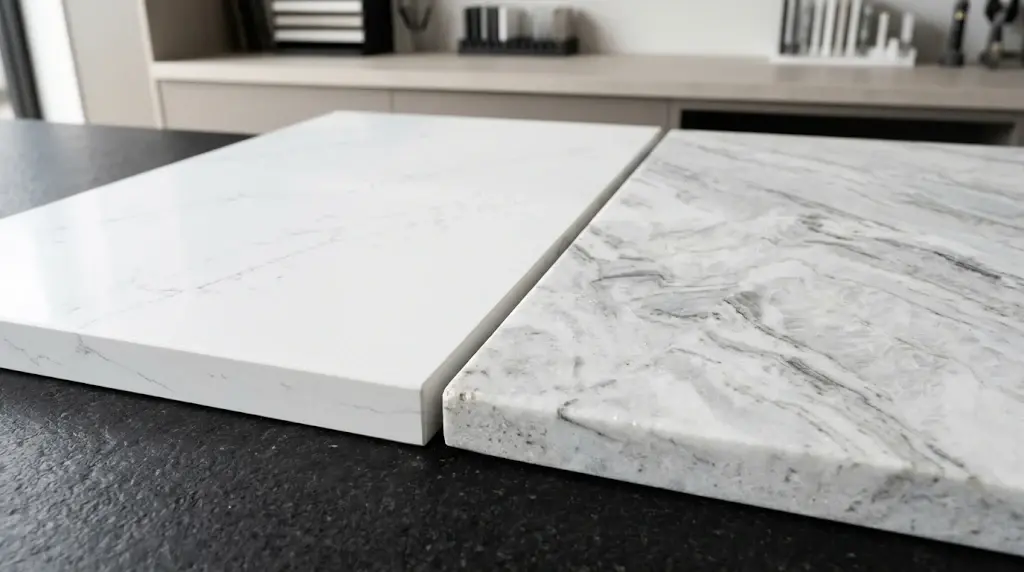
The biggest difference is how each material forms.
Engineered quartz comes from a manufacturing process. Producers combine crushed quartz with resin and other ingredients to create countertop slabs.
Quartzite is a natural metamorphic rock. It forms when quartz rich sandstone experiences intense heat and pressure over geological time.
The two materials may look similar, but their composition and performance differ.
What Is Engineered Quartz?
Engineered quartz is a manufactured surface used for kitchen countertops, bathroom vanities, and other interior applications.
Manufacturers combine crushed quartz minerals with binding materials, pigments, and other ingredients. They then form the mixture into slabs.
The exact composition varies by product and manufacturer. Do not assume every brand uses the same formula or follows identical care requirements.
Popular brands include Cambria, Caesarstone, and Silestone. Each offers different collections, colors, patterns, finishes, and product specifications.
Engineered quartz comes in many designs:
- Solid white and gray surfaces
- Black and dark colored designs
- Beige and cream patterns
- Marble inspired veining
- Concrete inspired finishes
- Speckled and granular patterns
- Modern and traditional colors
Manufacturing gives buyers more control over color and pattern consistency. This can help when several countertop sections need to match.
Engineered quartz also has practical benefits:
- It generally has a nonporous surface.
- It usually does not require sealing.
- It resists many ordinary household stains.
- It is available in many colors and designs.
- It needs simple daily cleaning.
- It works well for many kitchens and bathrooms.
However, engineered quartz has limitations.
Its resin content makes it vulnerable to excessive heat. It can also scratch, chip, or suffer damage from unsuitable chemicals.
A nonporous surface is not a damage proof surface. Use cutting boards, trivets, and manufacturer approved cleaning products.
What Is Natural Quartzite?
Quartzite is a natural metamorphic rock. It forms when quartz rich sandstone changes under intense heat and pressure.
During this process, the original sand grains recrystallize and bond together. The resulting rock contains a high amount of quartz.
Quarries extract large blocks of quartzite. Stone processors cut these blocks into slabs for countertops, flooring, wall panels, and other applications.
Natural quartzite has patterns created by geological processes. Some slabs have soft gray lines and cream backgrounds. Others show gold movement, green tones, or dramatic veins.
Popular commercial varieties include:
- Taj Mahal
- White Macaubas
- Cristallo
- Sea Pearl
- Perla Venata
- Blue Roma
These names describe commercial stone varieties. They do not guarantee identical mineral composition, porosity, or performance across every supplier.
Natural quartzite has several advantages:
- It is genuine natural stone.
- True quartzite has high scratch resistance.
- It generally handles kitchen heat better than resin based surfaces.
- Each slab has its own natural pattern.
- It can create a distinctive kitchen island or countertop.
However, quartzite is not maintenance free.
Some varieties absorb liquids more easily than others. Certain slabs benefit from an appropriate stone sealer. Exposed edges can also chip after a hard impact.
Fabrication and installation quality matter. Poor cabinet support, incorrect cutting, or rough handling can damage natural stone.
Are Quartz and Quartzite the Same Thing?
No. Quartz and quartzite are different.
Quartz is a mineral found in many types of rock. Manufacturers use crushed quartz as one of the main ingredients in engineered quartz countertops.
Quartzite is a natural rock made mainly of quartz minerals. It forms through geological changes to sandstone.
The distinction is simple:
- Quartz is a mineral.
- Engineered quartz is a manufactured countertop surface.
- Quartzite is a natural metamorphic rock.
The similar names create confusion in showrooms. Some sellers also use stone names loosely, which makes material identification important.
The Natural Stone Institute’s technical bulletin on quartzite explains the difference and discusses common mislabeling problems.
Quartz vs Quartzite: Side by Side Countertop Comparison
The following table compares the features that matter most to homeowners.
| Feature | Engineered Quartz | Natural Quartzite |
|---|---|---|
| Material | Manufactured surface | Natural metamorphic rock |
| Main composition | Crushed quartz, resin, pigments, and other ingredients | Mainly interlocking quartz minerals |
| Appearance | Controlled colors and patterns | Natural variation and unique veining |
| Porosity | Generally nonporous | Varies by slab |
| Sealing | Usually unnecessary | Depends on porosity |
| Scratch resistance | Good, but not scratch proof | Very high for genuine quartzite |
| Heat resistance | Limited by resin and product specifications | Generally higher |
| Stain resistance | Generally strong | Depends on porosity and sealing |
| Daily cleaning | Mild soap and suitable cleaners | Stone safe cleaner and suitable care |
| Slab variation | More controlled | Natural variation |
| Repairs | Matching repairs can be difficult | Depends on the stone and damage |
| Installation | Professional fabrication required | Professional fabrication required |
| Main advantage | Consistent appearance and simple care | Natural character and heat tolerance |
| Main concern | Heat and chemical damage | Porosity, identification, and slab variation |
One important point: natural quartzite does not perform identically in every situation. Its mineral structure, porosity, finish, and fabrication quality matter.
Engineered quartz products also differ by manufacturer. Always review the care guide for your chosen product.
Quartz vs Quartzite Appearance: Which Looks Better?
Appearance is often the first reason homeowners compare these materials.
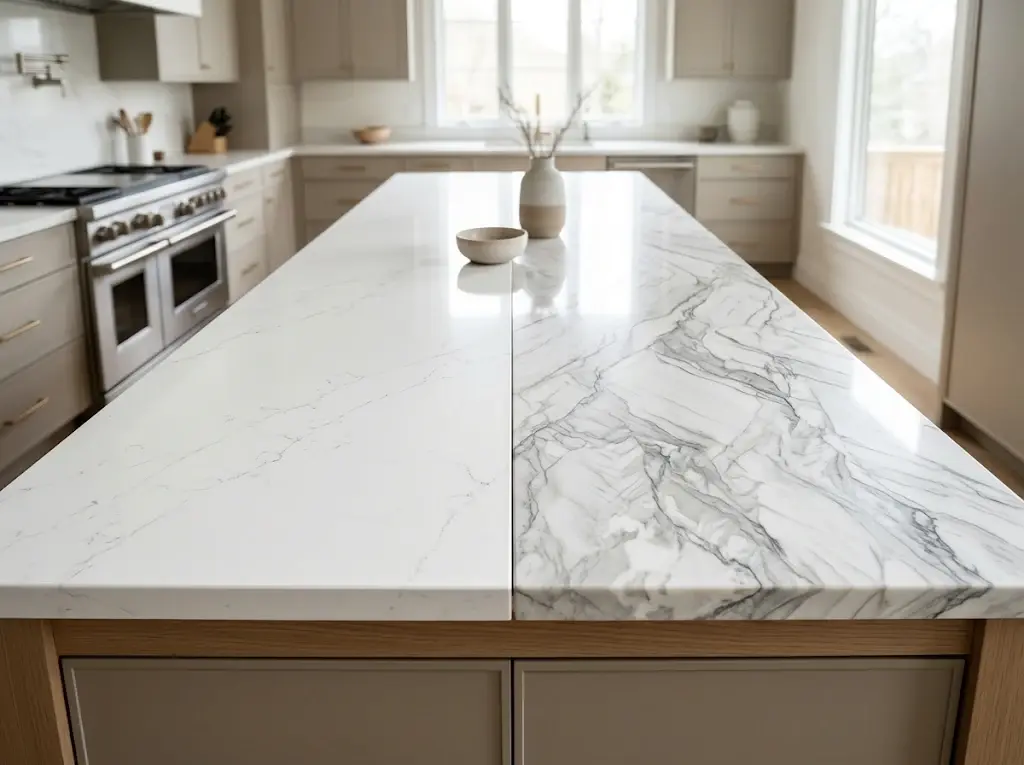
Both can create attractive kitchens, but they offer different visual results. Engineered quartz provides controlled designs. Natural quartzite offers variation created by geological processes.
Your choice depends on whether you prefer consistency or natural character.
Engineered Quartz: Consistent Colors and Modern Designs
Engineered quartz offers a wide range of colors and patterns. Manufacturers control the production process to create repeatable designs.
You can find white, gray, black, beige, and cream surfaces. Some products have subtle speckles. Others imitate marble veining or concrete.
This consistency helps when several countertop sections need to match.
For example, you may want the kitchen perimeter, island, and backsplash to follow one design. An engineered product can make that easier.
However, manufactured patterns may repeat. Some premium designs imitate natural stone movement, but they still follow a controlled production process.
Ask to see a large sample or full slab before ordering. A small sample cannot always show the complete pattern.
Cambria also explains that small samples may not represent every feature of the final slab. Review its official product care and product information before making a selection.
Quartzite: Natural Veining and One of a Kind Slabs
Natural quartzite has a different appearance. Its patterns develop naturally, so every slab can look different.
Some varieties have calm, marble like movement. Others feature strong veins, mineral patterns, and contrasting colors.
This makes quartzite popular for statement kitchen islands. A large slab can become the main visual feature of a kitchen.
Natural variation also creates a buying challenge. Two slabs with the same commercial name may not look identical.
Inspect the actual slab before approving fabrication. Check its background color, veins, mineral movement, patches, and visible flaws.
If your kitchen needs multiple slabs, ask the supplier to show how the patterns will align. This matters especially for waterfall islands and long countertop runs.
Polished, Honed, and Leathered Finishes
The finish affects how a countertop looks and feels.
Polished finish
A polished surface has a smooth, reflective appearance. It can make colors and patterns more noticeable.
It is a common choice for engineered quartz and natural stone.
Honed finish
A honed surface has a softer, matte appearance. It reflects less light than a polished finish.
Some homeowners prefer it for a more understated look. However, a matte finish does not automatically hide every mark or stain.
Leathered finish
A leathered finish has a textured surface. It can add depth and a more natural feel to certain stones.
Availability depends on the material and supplier. Not every engineered quartz collection offers this finish.
Inspect the finish under different lighting. Windows, overhead fixtures, and kitchen lighting can change how the surface looks.
Taj Mahal Quartzite vs Quartz: What Is the Difference?
Taj Mahal is a popular commercial name for a natural quartzite variety. It is known for warm cream, beige, and subtle gold tones.
Homeowners often choose it for a softer, marble inspired appearance.
Engineered quartz can imitate a similar color palette. It may offer more consistent patterns and simpler routine care.
The main difference is material identity.
Taj Mahal quartzite is natural stone. An engineered quartz product with a similar appearance is manufactured.
Do not assume a slab is Taj Mahal quartzite just because a seller uses that name. Ask for the material identification and inspect the actual slab.
Also ask about porosity, sealing, and recommended maintenance. Natural stone varieties can differ, even when their commercial names sound similar.
Quartz vs Quartzite Durability: Which Is Stronger?
Durability includes more than hardness. A countertop must handle scratches, impacts, spills, cleaning, and daily use.
Both materials can serve a home for many years when selected and installed correctly. However, they have different strengths.
Genuine quartzite is generally very hard. Engineered quartz offers a controlled and durable surface, but its resin content creates different limitations.
Scratch Resistance: Which Surface Scratches More Easily?
Genuine quartzite has high scratch resistance because it contains tightly bonded quartz minerals.
Quartz is a different type of countertop material. It contains crushed mineral particles held together with resin and other ingredients.
Both surfaces can scratch under the wrong conditions. Neither should be used as a cutting board.
Use a cutting board when preparing food. Avoid dragging heavy cookware, ceramic dishes, or rough objects across the surface.
Quartz has a Mohs mineral hardness of about 7. Genuine quartzite is also very hard because of its high quartz content.
However, mineral hardness does not provide a complete countertop durability rating. A finished countertop contains more than one ingredient and must withstand real world use.
Chipping and Cracking: Which Surface Handles Impact Better?
Both materials can chip or crack.
Quartzite can chip around corners, edges, sink openings, and exposed sections. The risk depends on the slab, fabrication, support, and impact.
Engineered quartz can also chip, especially around edges and cutouts. A hard impact from heavy cookware can damage either surface.
Cracks may develop when a countertop lacks proper support. Cabinet movement, incorrect installation, or stress around cutouts can also contribute.
To reduce the risk:
- Avoid dropping heavy objects on the countertop.
- Do not sit or stand on unsupported sections.
- Use a qualified fabricator.
- Confirm that cabinets provide proper support.
- Discuss sink and cooktop cutouts before fabrication.
- Protect exposed corners during construction.
The fabricator should inspect the slab and plan cutouts around its natural features. This is especially important for stone with visible fissures or veins.
What Is the Most Durable Countertop?
There is no single answer for every home.
Quartzite is a strong option when you want natural stone with high scratch resistance and better heat tolerance than resin based quartz.
Engineered quartz is a practical option when you want a consistent, nonporous surface with simple daily care.
Granite and porcelain also have their own strengths. Their performance depends on the specific product and how you use it.
For a busy kitchen, compare the full set of requirements. Consider heat, stains, scratches, maintenance, impact resistance, and repair options.
Do not choose a countertop based on one hardness number.
Quartz vs Quartzite Heat Resistance: Can You Put Hot Pans on Quartz?
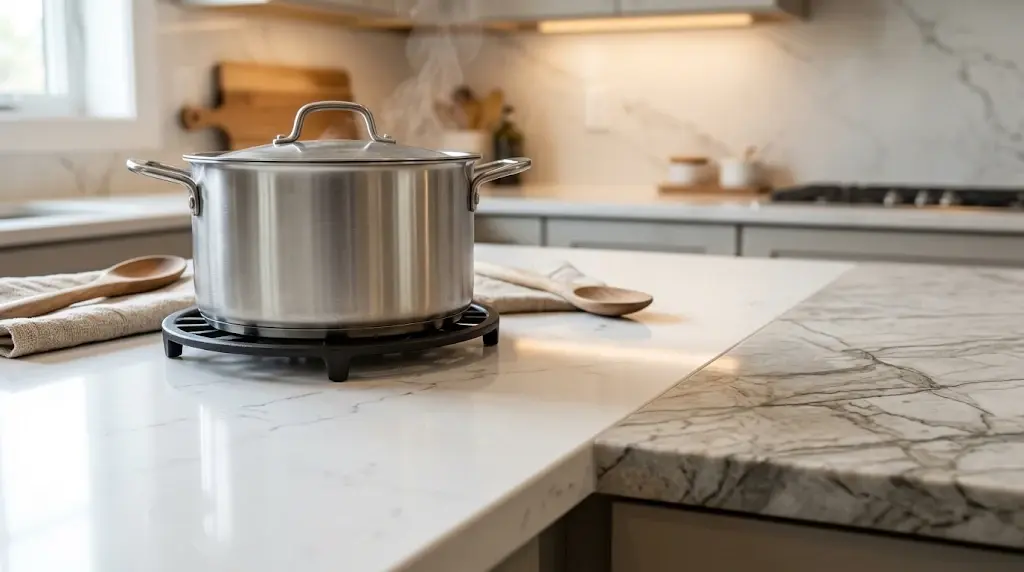
Heat resistance is one of the most important differences between these materials.
Kitchen countertops sit near ovens, cooktops, coffee machines, air fryers, and other heat sources. They may also come into contact with hot cookware.
Quartzite generally handles heat better than engineered quartz. However, that does not mean you should expose any countertop to unlimited heat.
How Much Heat Can Engineered Quartz Handle?
Engineered quartz contains resin. High temperatures can affect this binding material and damage the surface.
The exact temperature limits depend on the manufacturer and product. Do not rely on a general temperature claim found online.
Cambria warns that direct or sustained heat can damage its products. It recommends using a solid trivet or suitable hot pad under cookware and hot appliances.
Other manufacturers may have different product instructions. Check the care guide for your exact countertop.
A surface may develop discoloration, marks, or other damage after heat exposure. Repairs may not restore its original appearance.
Follow these precautions:
- Place hot pans on trivets.
- Use heat pads under hot appliances when required.
- Avoid placing hot cookware directly on the surface.
- Avoid sudden temperature changes.
- Follow the manufacturer’s care instructions.
Read Cambria’s official product care guidance for an example of brand specific heat precautions.
Is Quartzite More Heat Resistant Than Quartz?
Generally, yes.
Genuine quartzite is natural stone and does not rely on resin as its main binding material. It can tolerate normal kitchen heat better than engineered quartz.
That makes it attractive to homeowners who cook frequently.
However, heat resistance does not mean immunity to thermal shock. Extreme temperature changes can still damage stone under certain conditions.
A cold surface exposed to intense heat may experience stress. Existing cracks, weak areas, and installation problems can increase the risk.
Use a trivet as a sensible precaution. It protects the countertop and reduces the chance of thermal damage.
Can Heat Damage or Crack Either Countertop?
Yes. Both materials can suffer heat related damage.
Engineered quartz is more vulnerable because of its resin content. Quartzite generally performs better, but extreme heat or sudden temperature changes can still create problems.
Avoid placing hot cookware directly on either material. Follow the care instructions supplied with your slab or product.
If you plan to install a countertop near a grill, outdoor cooking area, or high heat appliance, confirm suitability with the manufacturer or stone professional.
Quartz vs Quartzite Stain Resistance: Which Is Easier to Maintain?
Stain resistance is another major buying concern.
Engineered quartz generally has a nonporous surface. This helps limit liquid absorption.
Quartzite is natural stone. Its porosity varies by variety and slab.
That means some quartzite surfaces need more protection than others.
Does Engineered Quartz Stain?
Engineered quartz usually resists common household stains well. Its nonporous surface makes routine cleaning easier.
However, it is not stain proof.
Strong pigments, prolonged spills, and unsuitable cleaners can damage some products. The exact risk depends on the product and manufacturer instructions.
Clean spills promptly. Pay particular attention to coffee, wine, oils, sauces, and strongly colored liquids.
Use a soft cloth and a suitable cleaner. Avoid harsh chemicals unless the manufacturer approves them.
Can Quartzite Countertops Stain?
Yes. Some quartzite slabs can absorb liquids and develop stains.
The level of absorption depends on the stone’s porosity. Not every variety behaves the same way.
A dense slab may need less protection. A more porous slab may benefit from an appropriate impregnating sealer.
Ask the supplier or fabricator to evaluate the exact slab. Do not rely only on the commercial stone name.
Before buying, ask:
- Has this slab been tested for porosity?
- Does it need sealing?
- Which sealer is suitable?
- How should spills be cleaned?
- What maintenance schedule does the fabricator recommend?
These questions can prevent problems after installation.
Staining vs Etching: What Is the Difference?
Staining and etching are different problems.
A stain occurs when a substance enters or remains on the surface and changes its appearance.
Etching is a chemical reaction that damages the surface finish. It may leave a dull spot or mark.
This distinction matters when comparing natural stones.
Genuine quartzite is mainly composed of quartz. It generally resists common household acids better than marble.
Marble and some dolomitic stones can react with acidic liquids. This can create dull spots even when the surface has been sealed.
Some slabs sold as quartzite may actually be marble or dolomitic marble. Buyers who expect genuine quartzite performance can end up with unexpected etching.
The Natural Stone Institute discusses this naming problem in its technical bulletin on quartzite identification.
Do not perform acid tests on an installed countertop. A qualified stone professional can assess a suitable sample.
Quartz vs Quartzite Maintenance: Does Quartzite Need Sealing?
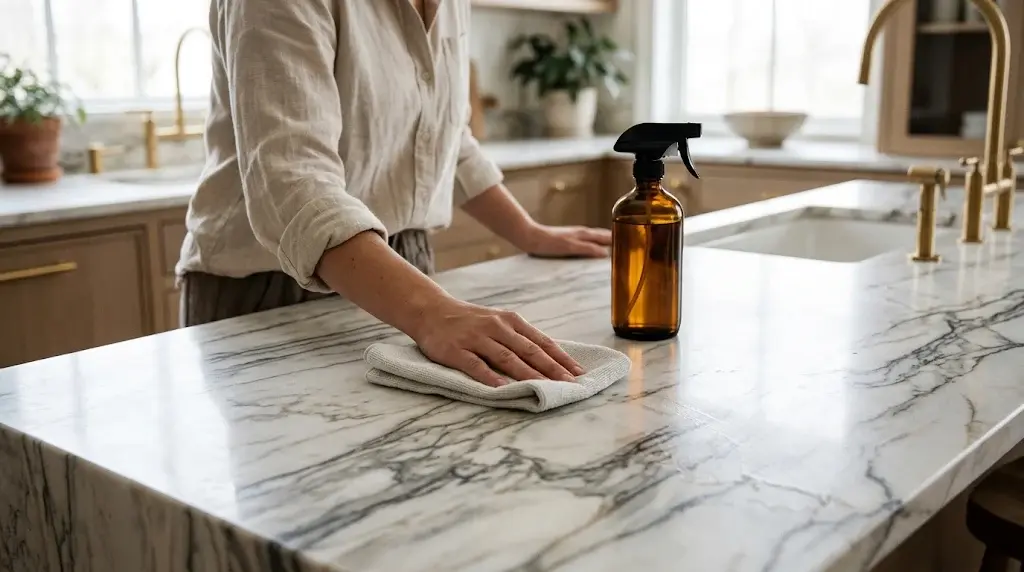
Maintenance is one of the strongest reasons homeowners choose engineered quartz.
Most engineered quartz products do not need sealing. Quartzite may need sealing depending on its porosity.
The correct care routine depends on the exact product or stone.
Does Engineered Quartz Need Sealing?
Most engineered quartz countertops do not require sealing.
Their manufactured surface is generally nonporous. Applying a natural stone sealer can be unnecessary and may conflict with the manufacturer’s instructions.
Cambria states that its quartz surfaces do not need sealing or polishing. It recommends warm water, a soft cotton cloth, and mild soap when needed.
Other brands may provide different product instructions.
Do not apply a sealer simply because someone recommends sealing every countertop. Check the care guide for your exact brand and collection.
Does Quartzite Need to Be Sealed?
Some quartzite slabs benefit from sealing. Others may be dense enough to need less protection.
The Natural Stone Institute explains that quartzite porosity varies. Some varieties are tightly bonded, while others absorb more liquid.
A suitable impregnating sealer can reduce liquid absorption. It does not make the stone completely stain proof.
Sealer performance also varies. Its useful life depends on the product, stone, application, and daily use.
There is no universal rule that every quartzite countertop needs resealing once a year.
Ask your fabricator to assess the slab and recommend a suitable product. Follow the sealer manufacturer’s instructions for application and maintenance.
A useful sign to discuss with your fabricator is darkening around a sink area after water exposure. It may indicate moisture absorption or reduced sealer performance.
Read Use Natural Stone’s quartzite care guide for more information about porosity and sealing.
How Do You Clean a Quartzite Countertop?
Daily cleaning is simple when you use suitable products.
For routine cleaning:
- Remove crumbs and loose debris.
- Use warm water and a soft cloth.
- Add a small amount of mild dish soap when needed.
- Wipe the surface gently.
- Rinse away soap residue.
- Dry the countertop with a clean cloth.
Clean spills promptly. Do not leave acidic liquids, oils, or strongly colored substances sitting on the surface.
Avoid abrasive pads and harsh cleaners unless a stone professional confirms they are safe for your slab.
For deeper cleaning, use a cleaner approved for natural stone.
The Natural Stone Institute recommends gentle cleaning methods and prompt spill removal. It also advises using protective items such as cutting boards and trivets.
Can You Use Clorox Wipes on Quartzite Countertops?
Do not assume every Clorox wipe is safe for every quartzite surface.
Cleaning products contain different ingredients. Some may affect a sealer or damage a stone finish.
Check the exact product label and your countertop care instructions. If the manufacturer does not approve the wipes, choose a cleaner made for natural stone.
A mild soap solution and soft cloth are usually a safer routine option.
Avoid mixing cleaning products. Never combine bleach with ammonia or acidic cleaners.
If you are unsure about a product, ask your stone supplier or restoration professional before using it on the countertop.
Quartz vs Quartzite Cost: Which Countertop Is More Expensive?
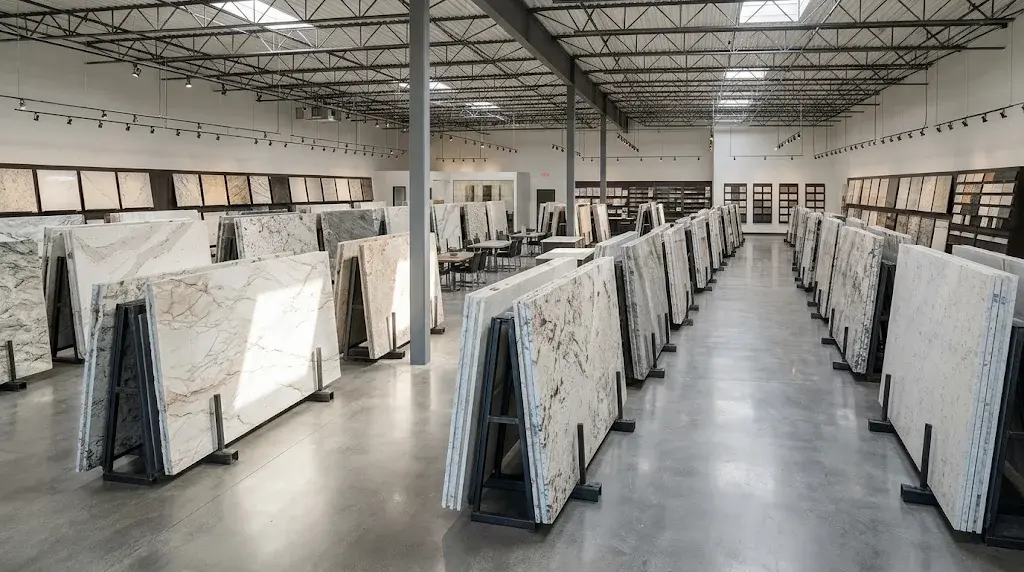
Price can influence the final decision.
Engineered quartz comes in several grades and designs. Natural quartzite also has a wide price range because appearance, rarity, and availability vary.
In the United States, the installed price depends on more than the slab. Fabrication, delivery, cutouts, edge profiles, and labor affect the final quote.
How Much Do Quartz Countertops Cost Per Square Foot?
Quartz pricing varies by brand, collection, grade, and project size.
Angi’s 2026 cost guide reports a national average project cost of about $4,500. It says most homeowners spend between $1,500 and $8,000.
The same guide lists some material grade prices separately. Its first choice quartz category starts around $80 per square foot, while its second choice category is around $50 to $60 per square foot.
These material grade figures should not be treated as a complete installed price.
For another comparison, Stonify’s 2026 US countertop cost guide gives an installed range of approximately $50 to $150 per square foot for engineered quartz. It places many kitchen projects in the $70 to $110 range.
Sources:
Use these figures as planning estimates, not guaranteed quotes. The price of a specific brand or premium collection may fall outside them.
How Much Do Quartzite Countertops Cost Per Square Foot?
Quartzite pricing depends on the stone variety, slab quality, color, and fabrication requirements.
Angi’s 2026 guide reports an installed range of approximately $80 to $220 per square foot.
Stonify’s 2026 cost guide gives a broader range of about $80 to $250 per square foot for quartzite. Its figures vary by stone variety.
Some premium varieties, including Cristallo and other rare stones, can cost more than common options.
Sources:
These estimates do not mean every quartzite slab costs more than every quartz product. Premium engineered quartz can overlap with natural stone prices.
Quartz vs Quartzite Price: What Is the Actual Difference?
The following figures provide a broad US planning comparison.
| Cost category | Engineered quartz | Natural quartzite |
|---|---|---|
| Typical installed planning range | $50 to $150 per sq. ft. | $80 to $250 per sq. ft. |
| Common project price drivers | Brand, collection, slab count, edge work | Stone variety, rarity, slab quality, fabrication |
| Sealing | Usually not required | Depends on porosity |
| Fabrication | Standard professional fabrication | Can require more specialized cutting |
| Pattern matching | Depends on product design | Natural vein matching can increase material needs |
The ranges come from Stonify’s 2026 US cost guide. Angi reports a quartzite installed range of $80 to $220 per square foot, showing that estimates differ by source and methodology.
Do not treat these ranges as a fixed national price list. Ask contractors to quote the same material, thickness, edge, cutouts, delivery, and installation scope.
Quartz vs Quartzite Installation and Fabrication Costs
Installation affects the final budget for both materials.
A countertop quote may include:
- Slab material
- Measurement and templating
- Cutting and fabrication
- Edge finishing
- Sink and cooktop cutouts
- Delivery
- Installation
- Sealing, when required
Some estimates exclude old countertop removal, plumbing work, backsplash installation, or cabinet repairs.
Quartzite can require careful handling and fabrication. Its hardness can increase tool wear and cutting time. Natural veins and fissures also affect how a fabricator plans the cuts.
Engineered quartz needs professional fabrication too. Large slabs are heavy, and accurate measurements matter.
Ask each contractor for an itemized quote. Compare the same scope of work before choosing a supplier.
What Affects the Final Countertop Price?
Several factors can change your total cost.
1. Countertop size
A larger kitchen needs more material. A large island may require additional slabs.
2. Slab quality and design
Rare natural stone varieties often cost more. Premium engineered quartz designs can also carry higher prices.
3. Thickness
Slab thickness affects material use, weight, edge appearance, and fabrication requirements.
4. Edge profile
A simple eased edge may be included in a standard quote. Decorative profiles can add fabrication costs.
5. Sink and cooktop cutouts
Each opening requires accurate fabrication. Complex cutouts can increase labor costs.
6. Backsplash and waterfall edges
Full height backsplashes and waterfall island panels need additional material and careful pattern matching.
7. Slab yield and seam placement
A dramatic natural pattern may create more waste during cutting. A book matched island may need two slabs selected for their matching veins.
Ask where seams will appear before fabrication begins. A seam near a sink or highly visible island area may affect the finished appearance.
8. Removal and disposal
Removing old countertops can add labor and disposal costs.
9. Delivery and access
Stairs, narrow hallways, difficult access, and heavy slabs can affect delivery and installation charges.
10. Local labor rates
Prices vary across the United States. Large metropolitan areas may have higher labor and operating costs than some smaller markets.
Get at least three written quotes. Make sure each contractor prices the same slab, thickness, edge, cutouts, and installation scope.
Quartz vs Quartzite vs Granite: Which Countertop Should You Choose?
Granite is another common countertop choice in American homes.
It is natural stone, like quartzite. However, granite forms through a different geological process and has its own mineral composition.
The three materials offer different benefits.
Quartz vs Quartzite vs Granite: Main Differences
| Feature | Engineered Quartz | Quartzite | Granite |
|---|---|---|---|
| Material | Manufactured | Natural stone | Natural stone |
| Appearance | Controlled designs | Natural veining | Mineral patterns and grains |
| Sealing | Usually unnecessary | Depends on porosity | Often recommended |
| Heat resistance | Limited by resin | Generally high | Generally high |
| Scratch resistance | Good | Very high for genuine quartzite | Generally high |
| Maintenance | Low | Varies by slab | Varies by slab |
| Pattern variation | Controlled | High | High |
| Main benefit | Simple daily care | Natural appearance and heat tolerance | Natural stone durability |
| Main concern | Heat damage | Porosity and slab identification | Sealing and maintenance |
Granite can be a strong choice for homeowners who want natural stone and a wide selection of colors.
Quartzite may appeal to buyers who want a marble like appearance with greater resistance to common household acids, provided the stone is genuine quartzite.
Engineered quartz suits people who prefer consistent designs and less routine maintenance.
Quartz vs Quartzite vs Marble
Marble is another natural stone that often enters this comparison.
It is known for its classic veining and elegant appearance. However, marble is generally more vulnerable to scratching and acid etching.
Genuine quartzite usually offers better resistance to common household acids. Engineered quartz also offers a nonporous surface, although heat remains a concern.
| Feature | Engineered Quartz | Quartzite | Marble |
|---|---|---|---|
| Material | Manufactured | Natural | Natural |
| Appearance | Controlled patterns | Natural variation | Distinctive veining |
| Acid resistance | Depends on product | Generally high for genuine quartzite | Low |
| Heat resistance | Limited by resin | Generally high | Generally high |
| Sealing | Usually unnecessary | Depends on porosity | Usually recommended |
| Maintenance | Low | Varies | Higher care |
| Main concern | Heat and chemical damage | Slab variation and porosity | Etching and staining |
Do not confuse marble with quartzite. Some stones sold under quartzite names may contain significant dolomite or marble like material.
If you want the appearance of marble without the same acid sensitivity, genuine quartzite may be worth considering. Confirm the stone’s identity before buying.
Quartz vs Quartzite for Kitchen and Bathroom Countertops
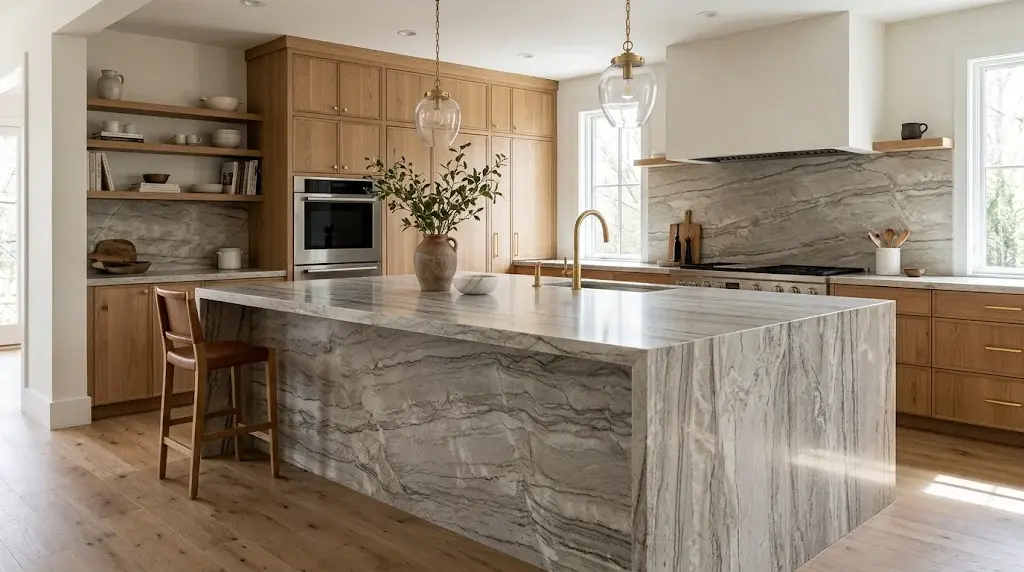
The best material can depend on where you plan to install it.
Kitchen counters face cooking heat, food spills, sharp tools, and frequent cleaning. Bathroom vanities deal with cosmetics, toiletries, water, and personal care products.
Both materials can work in these spaces. Their different care requirements should guide your choice.
Which Is Better for Kitchen Countertops?
Engineered quartz is a practical choice for many kitchens.
It offers consistent patterns, low daily maintenance, and strong resistance to ordinary household stains. It suits homeowners who want a clean appearance without routine stone sealing.
However, you must protect it from direct heat.
Quartzite can suit kitchens where natural stone appearance and heat resistance are priorities. It offers high scratch resistance when the material is genuine.
The main concern is porosity. Some slabs need sealing and more careful spill management.
Consider your routine:
- If you cook frequently, compare heat resistance and cleaning needs.
- If you want a natural statement island, inspect quartzite slabs.
- If you prefer consistent patterns, compare engineered quartz collections.
- If you want less routine maintenance, engineered quartz may be easier.
- If you want natural stone, quartzite may suit your design goals.
Your kitchen habits matter more than a general claim that one material is always better.
Which Is Better for Bathroom Countertops and Vanities?
Both surfaces can work well in bathrooms.
Engineered quartz is popular for bathroom vanities because it is generally nonporous and easy to clean.
Quartzite can create a distinctive natural appearance. It may work well on vanity tops and other stone surfaces when properly selected and installed.
Bathroom products can still cause problems. Hair dyes, cosmetics, nail products, and strong cleaners may damage some surfaces.
Wipe spills promptly. Follow the care instructions for the exact material.
Also consider the sink design, faucet holes, edge profile, and water exposure when planning fabrication.
Can You Use Quartz or Quartzite Outdoors?
Outdoor use requires extra care.
Engineered quartz is not automatically suitable for outdoor kitchens. Sunlight, heat, and environmental exposure can affect some products.
Check the manufacturer’s outdoor use approval before buying.
Natural quartzite may suit certain outdoor applications. However, performance depends on the exact stone, climate, finish, and installation.
Ask the supplier whether the slab is suitable for outdoor exposure. Consider direct sunlight, temperature changes, moisture, and freeze thaw conditions.
Never assume a countertop is outdoor rated simply because it is natural stone.
How to Tell Quartz vs Quartzite Before Buying
The names can be confusing in a showroom. A product may look like natural stone even when it is manufactured.
Confirm the material before signing a purchase agreement.
Check Whether the Material Is Engineered or Natural
Start by asking the seller for the exact material classification.
Engineered quartz is a manufactured surface. It contains crushed mineral material and binding ingredients.
Quartzite is a natural stone cut from a quarried block.
Ask for the manufacturer’s product sheet or the stone supplier’s identification details.
If the seller cannot explain what the material is, pause the purchase.
Inspect the Slab and Its Natural Patterns
Natural quartzite usually has variation across the slab. Its veins, mineral movement, and color distribution develop naturally.
Engineered quartz often has more controlled patterns. Some premium designs imitate natural movement, so appearance alone cannot prove material identity.
Inspect the actual slab rather than relying only on a small sample.
Check for:
- Natural color variation
- Vein movement
- Visible fissures
- Surface consistency
- Repairs or filled areas
- Differences between multiple slabs
- Areas that appear unusually weak or damaged
Ask the fabricator how the veins will align across seams and corners.
Understand Fissures, Cracks, and Filled Areas
Natural stone can contain visible lines and mineral features. Not every line is a structural crack.
A fissure is a natural separation or feature within the stone. A crack may indicate damage or a structural weakness.
The two should not be treated as the same thing.
Ask the fabricator to inspect visible lines and explain whether they affect the slab’s strength or fabrication plan.
Some slabs also contain filled or repaired areas. These may be acceptable, depending on the material and location, but you should know about them before buying.
Ask the supplier to identify repairs and discuss any effect on appearance, durability, and warranty coverage.
Watch Out for Quartzite That Is Actually Marble or Dolomite
This is an important issue when buying natural stone.
Some materials sold as quartzite are actually marble or dolomitic marble. These stones can behave differently when exposed to acidic liquids.
The Natural Stone Institute has published guidance about this naming problem.
A professional can help identify the stone using suitable tests and material knowledge.
Do not pour vinegar or another acid on an installed countertop to identify it. Such testing can damage acid sensitive stone.
Ask the supplier to confirm the material before fabrication. Keep the identification in writing.
The stone’s country of origin, price, and commercial name do not prove its geological identity.
Questions to Ask Your Stone Supplier or Fabricator
Use these questions before placing an order:
- Is this engineered quartz or natural quartzite?
- What is the exact brand or stone variety?
- Can I inspect the full slab?
- Has the natural stone been tested for porosity?
- Does this slab need sealing?
- Which sealer do you recommend?
- What care products should I avoid?
- Are there visible fissures, cracks, or filled areas?
- What is included in the installation quote?
- How many slabs will my project require?
- Where will the seams appear?
- How will you match the veins across the seams?
- What happens if the slab chips during fabrication?
- Does the manufacturer provide a warranty?
- Is the product suitable for my intended location?
- Can I receive the care instructions before installation?
A reliable supplier should answer these questions clearly.
Quartz vs Quartzite Pros and Cons
Each material has advantages and limitations. Review both sides before making your decision.
Engineered Quartz Pros and Cons
Pros
- Usually does not need sealing.
- Offers consistent patterns and colors.
- Has a generally nonporous surface.
- Handles ordinary household spills well.
- Comes in many styles and finishes.
- Requires simple daily cleaning.
- Works well for many kitchen and bathroom projects.
Cons
- Direct heat can damage the surface.
- It can scratch or chip.
- Harsh chemicals may cause damage.
- Some premium designs can be expensive.
- Repairs may remain visible.
- Natural stone variation is not the same as manufactured patterning.
- Outdoor suitability depends on manufacturer approval.
Natural Quartzite Pros and Cons
Pros
- It is genuine natural stone.
- It offers distinctive patterns and veining.
- Genuine quartzite has high scratch resistance.
- It generally handles kitchen heat better than engineered quartz.
- It can create a distinctive appearance.
- Some varieties offer a marble inspired look with better acid resistance.
Cons
- Some slabs need sealing.
- Porosity varies between varieties.
- Natural patterns differ from slab to slab.
- Certain varieties can be expensive.
- It can chip or crack under impact.
- Mislabeling can create confusion.
- It needs careful inspection before purchase.
The right choice depends on which limitations you can manage.
How Long Do Quartz and Quartzite Countertops Last?
Both materials can remain in service for many years. However, there is no single lifespan that applies to every countertop.
The useful life depends on product quality, installation, daily use, and maintenance.
What Affects Engineered Quartz Lifespan?
Engineered quartz can provide many years of service when installed and maintained correctly.
Its main risks include heat damage, edge chips, scratches, and chemical damage.
Protect the surface from hot cookware. Avoid cutting directly on it. Use suitable cleaners and follow the manufacturer’s instructions.
Also check the warranty before purchasing. Some warranties cover manufacturing defects but exclude damage caused by heat, misuse, or improper installation.
What Affects Quartzite Lifespan?
Natural quartzite can also provide many years of service.
Its hardness helps it resist ordinary scratching. However, impacts, poor support, incorrect fabrication, and neglected maintenance can cause problems.
The slab’s porosity also matters. A suitable sealer can help reduce liquid absorption when the stone needs protection.
Inspect the stone before installation. Discuss visible fissures, filled areas, edge details, and cabinet support with the fabricator.
Does One Material Have Better Long Term Value?
Long term value depends on more than lifespan.
Consider:
- Initial material price
- Fabrication and installation
- Sealing requirements
- Cleaning and maintenance
- Repair costs
- Design preferences
- Warranty coverage
- How well the material suits your daily routine
Engineered quartz may offer value through simple maintenance and predictable patterns.
Quartzite may offer value through natural stone character, high scratch resistance, and better heat tolerance.
Neither material guarantees a higher resale price. Buyer preferences, kitchen design, property condition, and local housing markets influence resale value.
Quartz or Quartzite: Which One Should You Choose?
There is no universal winner. Choose the material that matches your kitchen habits, budget, design goals, and maintenance preferences.
Choose Quartz If You Want…
Engineered quartz may be the better choice if you want:
- A consistent color and pattern.
- Simple daily cleaning.
- A surface that usually does not need sealing.
- A wide range of manufactured designs.
- A practical option for a busy household.
- A coordinated look across several countertop sections.
It works well when you want a predictable appearance and low routine maintenance.
Remember to protect it from hot cookware and follow the manufacturer’s care instructions.
Choose Quartzite If You Want…
Natural quartzite may be the better choice if you want:
- Genuine natural stone.
- Distinctive natural veining.
- High scratch resistance.
- Better heat tolerance than resin based quartz.
- A unique kitchen island or statement surface.
- A natural material with a marble inspired appearance.
You should be comfortable inspecting slabs and following the recommended stone care routine.
Ask about porosity and sealing before purchase.
Which Material Is Better for Families and Busy Kitchens?
For many busy households, engineered quartz is easier to maintain.
It generally resists ordinary spills and does not need routine sealing. That can make everyday cleaning simpler.
However, families must still protect it from hot pans, sharp tools, and strong chemicals.
Quartzite can also work well in a family kitchen. It offers natural stone durability and better heat tolerance. But the exact slab matters.
A more porous variety may need additional care. Frequent cooking and spills make cleaning habits important.
Think about your household’s routine. The easier material to maintain is not automatically the more durable material in every category.
Which Material Offers Better Long Term Value?
Engineered quartz may offer value through low routine maintenance and consistent appearance.
Quartzite may offer value through natural stone character, scratch resistance, and heat tolerance.
Neither material guarantees a higher resale price or a specific lifespan.
Compare written installation quotes. Ask about warranties, care requirements, and repair options.
A lower initial price may not represent the best choice if the material does not suit your lifestyle.
Frequently Asked Questions About Quartz vs Quartzite
Are quartz and quartzite different?
Yes. Engineered quartz is a manufactured countertop surface made with crushed quartz and binding ingredients. Quartzite is a natural metamorphic rock formed from sandstone under heat and pressure.
Is quartz or quartzite more expensive?
Quartzite often costs more than standard engineered quartz, but the prices can overlap. Rare natural stone and premium engineered quartz designs can both carry high prices. Compare installed quotes for the exact products.
Is quartzite harder than quartz?
Genuine quartzite is very hard because it contains tightly bonded quartz minerals. However, engineered quartz is a composite material. Mineral hardness alone cannot predict the complete performance of a countertop.
Is quartz more durable than quartzite?
It depends on the type of damage. Engineered quartz is generally easier to maintain and resists ordinary spills well. Genuine quartzite generally offers better heat tolerance and high scratch resistance. Both can chip or crack.
Does quartz or quartzite need to be sealed?
Most engineered quartz products do not need sealing. Quartzite may need sealing depending on the slab’s porosity. Ask your fabricator to assess the exact stone.
Can quartzite scratch?
Yes, but genuine quartzite has high scratch resistance. Heavy impacts, abrasive materials, and improper use can still damage the surface. Use cutting boards and avoid dragging rough objects across it.
Will quartzite crack?
Quartzite can crack under impact, stress, poor support, or incorrect installation. Proper cabinet support, fabrication, transport, and installation help reduce the risk.
How much more expensive is quartzite than quartz?
There is no fixed price difference. Standard engineered quartz may cost less than many quartzite varieties. Rare quartzite slabs can cost substantially more. Compare the full installed price for the exact products.
Is quartzite better than quartz for a kitchen?
Quartzite may be better if you prioritize natural stone, scratch resistance, and heat tolerance. Engineered quartz may be better if you want consistent patterns and simple maintenance. Your cooking habits should guide the choice.
Is quartzite a natural stone?
Yes. Quartzite is a natural metamorphic rock. It forms when quartz rich sandstone changes under heat and pressure.
Is quartz man made?
Quartz itself is a natural mineral. Engineered quartz countertops are manufactured products made using crushed quartz, resin, pigments, and other ingredients.
Does quartzite stain if it is sealed?
It can. Sealing reduces liquid absorption, but it does not make every stone completely stain proof. Clean spills promptly and follow the sealer manufacturer’s instructions.
Can quartzite countertops stain?
Yes. Some varieties are more porous than others. Oils, wine, coffee, and other liquids may stain an unprotected or porous surface. Ask whether your slab needs sealing.
Is quartzite easier to maintain than quartz?
Usually not. Engineered quartz generally needs less routine maintenance because it does not usually require sealing. Quartzite care depends on its porosity and the sealer used.
Can you use quartz cleaner on quartzite?
Only if the cleaner’s manufacturer confirms that it is suitable for natural stone. Check the product label and your stone care instructions. A mild soap solution or approved stone cleaner is a safer routine choice.
What is the difference between Taj Mahal quartz and Taj Mahal quartzite?
Taj Mahal quartzite is a natural stone variety. An engineered quartz product with a similar appearance is manufactured. Confirm the exact material with the supplier before buying.
Is quartzite better than marble for countertops?
Genuine quartzite generally resists common household acids better than marble. Marble is more likely to etch when exposed to acidic liquids. However, some stones sold as quartzite may actually be marble or dolomitic material.
Can quartzite be used for an outdoor kitchen?
Some quartzite products can work outdoors, but suitability depends on the stone, climate, finish, and installation. Ask the supplier to confirm outdoor suitability before purchasing.
Final Verdict: Which Countertop Is Right for Your Home?
Engineered quartz and natural quartzite can both be excellent countertop choices. Their differences become clear when you compare maintenance, heat resistance, appearance, and price.
Engineered quartz is a strong option for homeowners who want consistent designs and easy daily care. It usually does not require sealing, but it needs protection from direct heat.
Natural quartzite suits homeowners who prefer genuine stone, natural patterns, and better heat tolerance. Its porosity varies, so slab inspection and proper care matter.
Before choosing, inspect the actual slab or product. Confirm its identity, review the care instructions, and compare complete installation quotes.
The best choice is the material that suits your home, budget, and daily routine.